Best Sales Onboarding Software for B2B Teams: A Buyer's Guide
How to pick sales onboarding software for B2B teams: onboarding vs enablement, 8 tools compared from their own pages, and a plan to ramp 10 new AEs faster.

TL;DR
The best sales onboarding software for a B2B team is the one that gets a new rep to a first real deal faster, not the one with the biggest course library. Judge it on practice built from your own calls and coaching per rep. The Bridge Group puts average AE ramp at 6.2 months, its highest ever.
Why sales onboarding got harder
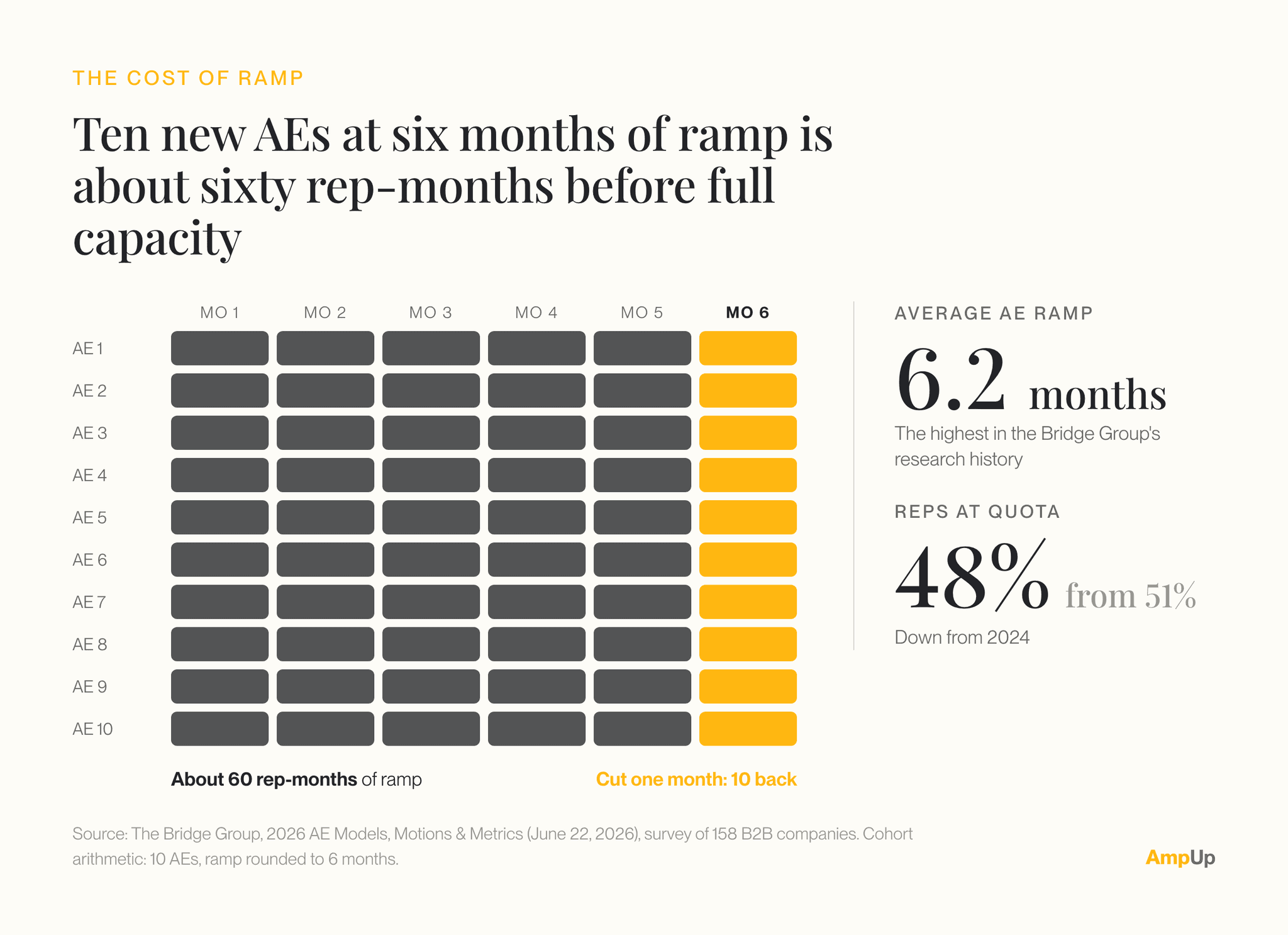
New account executives now take longer to become productive than at any point in the Bridge Group’s research. Its 2026 AE Models, Motions & Metrics report, published June 22, 2026 from a survey of 158 B2B companies, puts average AE ramp time at 6.2 months, the highest in the study’s history. The same report finds 48% of reps at quota, down from 51% in 2024.
Do the arithmetic on a hiring plan. If you hire ten AEs this quarter and each takes about six months to ramp (the 6.2-month average, rounded), that’s roughly sixty rep-months of ramp (6.2 x 10 = 62), paid for before the cohort sells at full capacity. Every month you take off that ramp is ten rep-months back.
So the question a sales onboarding platform has to answer is simple: what does it do to time-to-first-deal? Content, quizzes and certifications matter only to the extent they move that number.
Sales onboarding platforms vs sales enablement tools: what’s the difference?
The two categories overlap so much that most vendors sell both, which is why buyers get confused.
Sales enablement tools manage what sellers use: content libraries, pitch decks, battlecards, guided selling, and analytics on which content buyers open. Their user is every rep, every day, for as long as they work there.
Sales onboarding platforms manage how a new seller becomes productive: learning paths, certifications, practice, coaching and readiness tracking. Their user is the new hire, intensely, for the first few months, and then every rep again when a product or a pitch changes.
Which should you buy? If your new reps can find the right deck but still freeze on the first hard question, you have an onboarding problem, and more content will not fix it. If your reps cannot find the current pricing sheet, you have an enablement problem. In our experience, teams often have the first problem and buy for the second.
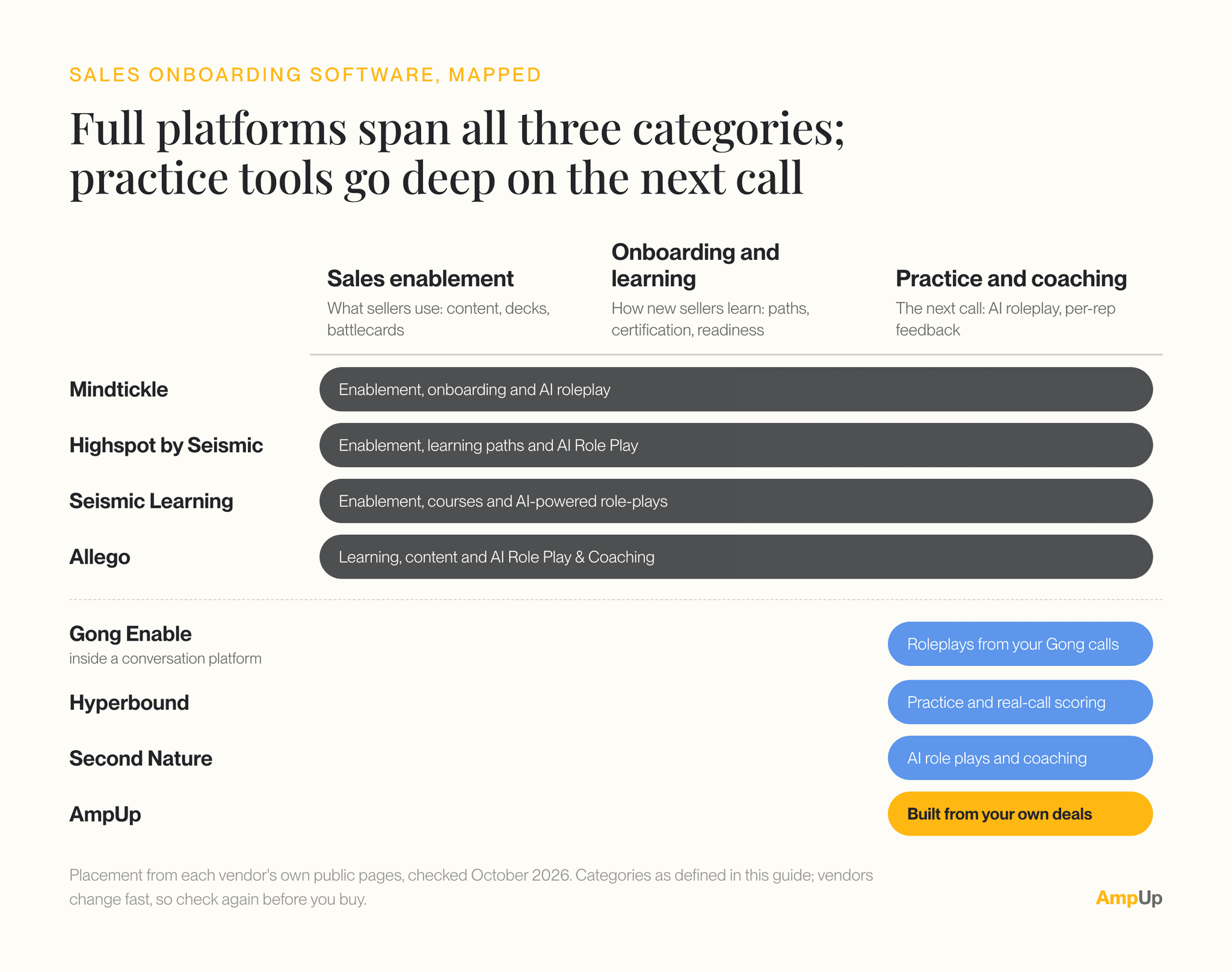
There is a third category worth naming: practice and coaching tools, which sit on top of the other two. They don’t store content or host courses. They put the new rep in front of an AI buyer, score how they did, and connect that practice to their live calls. AmpUp is in this category, and so are dedicated roleplay tools. Our view, and you should weigh it knowing we build one: this is the layer that changes what a new rep says on the next call.
What to look for in sales onboarding software
I’ve seen a lot of onboarding programs that looked great in a QBR deck: 100% course completion, everyone certified, a nice readiness dashboard. Then the cohort went live and the first ten calls sounded like the first ten calls always sound. Here is what I’d put on the evaluation sheet instead.
1. Is practice built from your own calls? A new rep’s first real objection should not be the first time they hear it. The strongest onboarding programs put new hires in front of the buyers who actually beat your team, built from your recorded calls, not from a generic persona library. Ask each vendor to build a roleplay from one of your recordings during the trial.
2. Is coaching per rep? Ten new AEs will have ten different gaps. One over-talks, one skips discovery, one panics on pricing. A program where everyone gets the same module and the same quiz is a course, not coaching.
3. Does it learn from your top reps? What your best rep says when a buyer goes quiet is the most valuable onboarding content you own, and it usually lives only in their head. Look for a tool that finds what top performers do differently from outcomes, then teaches it. Working from outcomes is how we found that assumptive closing was the behavior most correlated with deals moving at one AmpUp customer, and nobody there had ever coached it.
4. Does it connect to live calls? Onboarding does not end on go-live day; that’s when it starts to count. The tool should see the new rep’s live calls, find the gap and assign the next drill. If it can’t, you are buying half a loop.
5. Does it land where reps already work? A portal new reps must remember to open gets opened in week one. Coaching that arrives in the calendar invite, the CRM or the chat tool they already use gets used.
6. Does it measure ramp, not activity? Course completions prove attendance. Measure behaviors on live calls and time-to-first-deal. Amit wrote about this in detail in how to prove your sales training worked.
Best sales onboarding software for B2B teams: 8 tools compared
The short answer, if you’re asking which platforms teams use to onboard new reps: Mindtickle, Highspot by Seismic, Seismic Learning and Allego are the full enablement and onboarding platforms; Gong Enable covers training for teams already on Gong; and AmpUp, Hyperbound and Second Nature are practice and coaching tools that sit on top, with AmpUp building practice from your own lost calls. Which one fits depends on whether you’re missing a content and course stack or missing practice tied to live calls.
Last checked October 2026. Each tool is described from its own public pages; follow the links and check again before you buy, because this category changes fast (Seismic and Highspot announced their merger in February 2026). None of the vendors below publish list prices as of this check, so every price is “ask sales.” The order below is not a ranking. Where a vendor quotes customer results, they are the vendor’s own figures, not ours.
| Tool | What it is, in its own words | Category | AI roleplay | Pricing (public) |
|---|---|---|---|---|
| AmpUp | Coaching and practice layer on top of your call recorder and CRM. Finds what wins in your own deals, then turns it into pre-call briefs, per-rep coaching and roleplays built from your real calls. | Practice and coaching | Yes, built from your team’s real deals and lost calls | Not listed; book a demo |
| Mindtickle | Revenue enablement platform to “onboard, everboard, and enable your sellers fast,” with personalized programs that combine practice, reinforcement and certification. | Onboarding and enablement | Yes, AI role-plays | Not listed; demo |
| Highspot by Seismic | Enablement platform with onboarding and ongoing training, adaptive learning paths and AI feedback after calls. Its site says “Highspot is part of Seismic.” | Enablement and onboarding | Yes, AI Role Play by persona, product or deal | Request form |
| Seismic Learning | AI-powered sales training with tailored lessons, interactive courses and practice exercises to bring new sellers up to speed. | Enablement and onboarding | Yes, “AI-powered role-plays” | Not listed; demo |
| Allego | Learning, content and coaching in one platform, with mobile-first training “that fits their flow of work.” | Enablement and onboarding | Yes, AI Role Play & Coaching | Not listed |
| Gong Enable | Sales training and enablement inside Gong. New reps “binge-watch curated playlists of winning calls,” and AI Trainer builds roleplays from your own sales calls. | Sales training and coaching, inside Gong | Yes, built from your Gong calls | Not listed; demos and pilots |
| Hyperbound | AI sales coaching: Practice (AI buyer roleplays “built around your sales process and what your best reps do”), Perform (real-call scoring) and Kota Activate, which it says connects calls, deals and practice to deliver coaching and next steps where reps already work. | Practice and coaching | Yes | Pricing page, no figures; free roleplay trial |
| Second Nature | ”AI role plays and coaching that turn training into go-to-market execution.” Says it “integrates with any LMS via SCORM or LTI.” | Practice and coaching | Yes | Not listed; demo |
A few notes on the table. AmpUp is listed first because it’s ours; the rest are grouped by category.
Mindtickle, Highspot by Seismic, Seismic Learning and Allego are the full-platform choices: content, courses, certification, coaching and practice in one place. If you have no enablement stack and a dedicated enablement team to run it, start here. All four now advertise AI roleplay, so ask the same question of each: where does the scenario come from, and does the next drill change based on what this rep did on their last live call?
Gong Enable is the “you may already own this” entry. If your team records calls in Gong, test its onboarding features before adding a vendor. The curated-playlist approach is a good one; the same per-rep question applies.
Hyperbound and Second Nature are dedicated practice tools and the closest alternatives to AmpUp. Both run strong roleplays. We keep dated comparisons: AmpUp vs Hyperbound and AmpUp vs Second Nature. For the platforms, see AmpUp vs Highspot and AmpUp vs Seismic.
Where AmpUp fits, stated plainly so you can check it: it does not replace your LMS, your content library or your call recorder. It sits on top of them, learns which behaviors move deals forward in your own calls, and turns that into a brief before each call, coaching after it, and roleplays built from the calls your team lost. Our sales onboarding and ramp page shows how that works for new hires.
This guide is about onboarding: getting a new rep to a first deal. If you’re choosing training software for the whole team, our separate comparison of sales training platforms for the whole team covers that question.
What AI-powered sales onboarding tools should do for SaaS teams
Every tool in the table says “AI.” For a SaaS team ramping AEs, here is what the AI should do, in order of how much it moves ramp time.
It should find what your best reps do differently. In the table, AmpUp and Hyperbound describe this directly. Not from a scorecard someone wrote in advance, but from outcomes: which behaviors show up in deals that progress and are missing from deals that stall. That becomes the curriculum.
It should build practice from your real buyers. AmpUp and Gong Enable say they build roleplays from your own calls. A SaaS AE will hear “we’re already using a competitor,” “this isn’t budgeted until next year,” and “send me something” in the first week. The roleplay should use those objections in your buyers’ words, from your calls. Our post on AI cold call training software goes deeper on what good AI practice feedback sounds like.
It should prep the rep before every live call. A new AE doesn’t know the account, the people in the room or the objection that is coming. A one-page brief before the call does more for a first meeting than a module watched three weeks earlier. See our meeting prep page for how AmpUp does this.
It should coach every call, not a sample. A manager with eight reps can listen to a few calls a week. AI can review every one and turn the gap into the next drill.
How to reduce time-to-first-deal for 10 new AEs
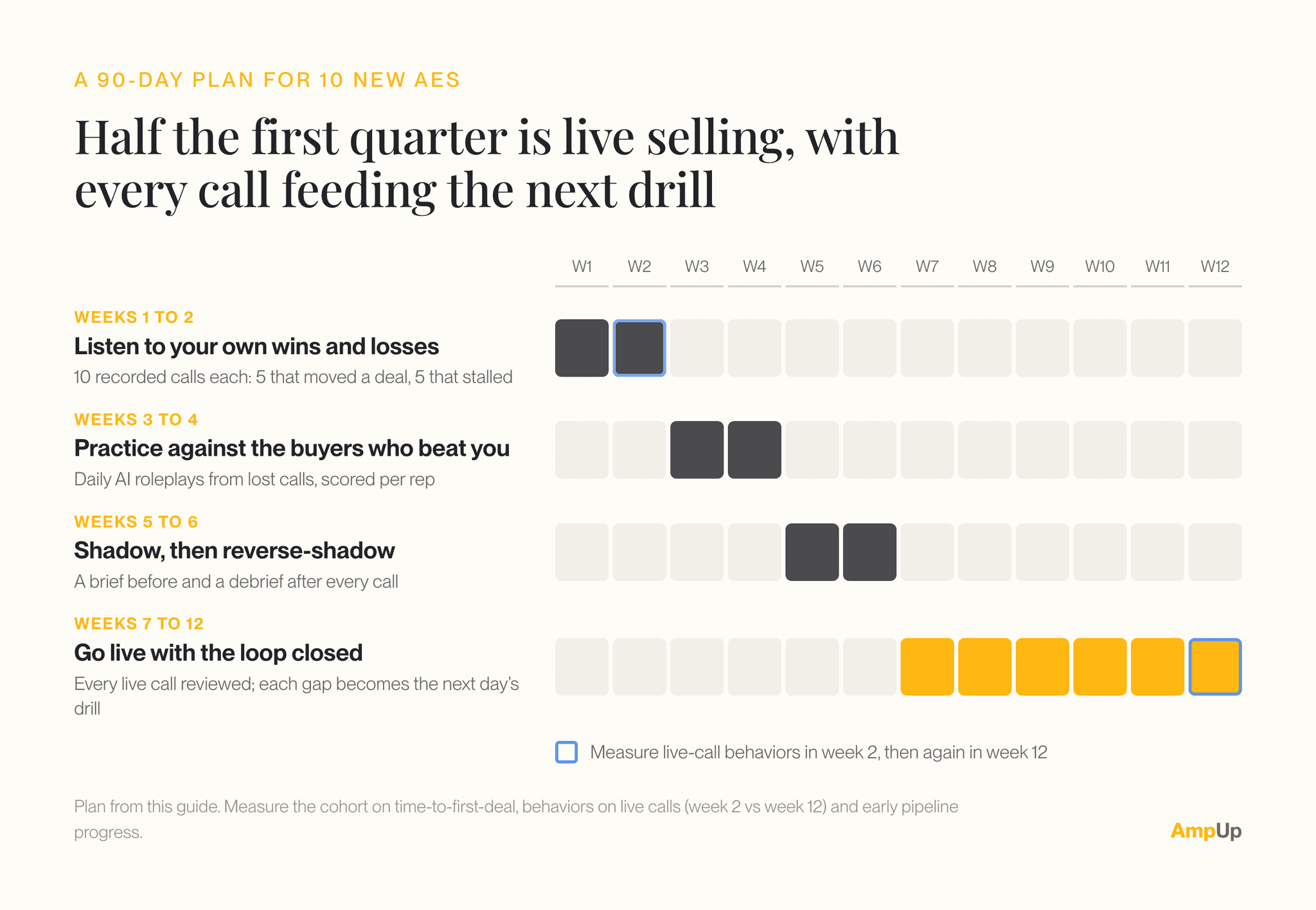
If you’re hiring ten new AEs this quarter, here is the 90-day plan I’d run for the cohort, with whichever tool you pick. Without one, the manager does each step and does it less often.
Weeks 1 to 2: listen to your own wins and losses. Each new AE listens to ten recorded calls from your team, five that moved a deal forward and five that stalled it. They write down every objection and how your best reps answered it. This is the curriculum, and it’s free.
Weeks 3 to 4: practice against the buyers who beat you. Daily AI roleplays built from those lost calls. Every rep gets scored, and every rep’s next roleplay targets their own weakest moment. Certify on the conversations, not on a product quiz.
Weeks 5 to 6: shadow, then reverse-shadow. New AEs sit in on live calls, then run calls with a senior rep listening. Every call gets a brief beforehand and a debrief after.
Weeks 7 to 12: go live with the loop closed. Every live call is reviewed. Any gap becomes the next day’s drill, built from that call. The manager’s one-on-one starts from the data, not from memory.
Measure the cohort on three things: time-to-first-deal, behaviors on live calls (discovery depth, objection recovery, next step agreed) in week 2 versus week 12, and how early each rep’s pipeline starts progressing. Course completions don’t make the list.
Frequently asked questions
What is sales onboarding software? Software that takes a new seller from day one to productive: learning paths, certification, practice, coaching and readiness tracking. The best tools also connect practice to the new rep’s live calls, so onboarding keeps working after go-live.
What’s the difference between sales onboarding and sales enablement? Enablement manages what every seller uses every day (content, decks, battlecards). Onboarding manages how a new seller becomes productive (learning, practice, coaching). Many platforms do both; practice and coaching tools like AmpUp sit on top of either.
How long does it take to ramp a new AE? The Bridge Group’s 2026 report puts average AE ramp time at 6.2 months across 158 B2B companies, the highest in its history. Your number depends on deal size and cycle length; measure your own time-to-first-deal before and after any tool.
Do I need an LMS for sales onboarding? Not necessarily. If you already run one, keep it; practice tools such as Second Nature advertise SCORM and LTI support, and AmpUp sits on top of what you already run. If you don’t, a full enablement platform or a practice tool built from your own calls may cover what you need.
How much does sales onboarding software cost? None of the eight vendors in this guide publish list prices as of October 2026, so every price is “ask sales.” Budget by comparing quotes against what a month of ramp costs you: with ten new AEs, every month of ramp you cut gives back ten rep-months.
How do you measure sales onboarding success? Measure the cohort on time-to-first-deal, on behaviors in live calls (discovery depth, objection recovery, next step agreed) in week 2 versus week 12, and on how early each rep’s pipeline starts progressing. Course completions prove attendance, not ramp.
Where to start
Pick one number before you pick a tool: your current time-to-first-deal for the last cohort. Then run a two-week trial on the next one, with practice built from your own recorded calls, and see whether that number moves. If you want to see what that looks like with AmpUp, book a demo and bring one call your team lost; we’ll build the roleplay from it.

Book a demo with us
See how AmpUp turns every call into a coaching opportunity.
Written by

Rahul Goel
Co-Founder & Head of AI & Growth, AmpUp
Rahul is the co-founder of AmpUp and former Lead for Tool Calling at Gemini. He brings deep expertise in AI systems, reasoning, and context engineering to build the next generation of sales intelligence platforms.
Stay up to date with AmpUp
Follow AmpUp on LinkedInFollow us on LinkedIn for the latest on AI-powered revenue intelligence.