AI Cold Call Training Software: A Buyer's Guide for B2B Teams
A buyer's guide to AI cold call training for B2B teams: AI practice vs AI dialers, 8 tools compared (checked October 2026), and a 30-day program for new hires.

TL;DR
AI cold call training software lets reps rehearse against an AI buyer and get feedback before they dial a real lead. Buy on three things: whether the roleplays are built from your own calls, whether feedback is per rep, and whether practice lands where reps already work. Below: the dialer confusion, 8 tools, and a 30-day program.
What “AI cold call training” actually means (and what it doesn’t)
Search for “AI cold calling software” and you get two very different categories mixed together, which is why so many buyers come in with the wrong shortlist.
The first category is dialers and auto-callers. Parallel dialers, power dialers, voicemail drops, local presence, AI agents that make the call for you. These tools get more conversations per hour out of a rep. They do not make the rep better at the conversation. Orum and Nooks started here, and both have added coaching on top, which is part of the confusion.
The second category is AI practice and coaching. A simulated buyer picks up, pushes back, and the rep works the call. Afterwards the software scores the attempt and tells the rep what to do differently. Hyperbound, Second Nature and Quantified live here, and so does AmpUp. Gong and Salesloft have added practice or coaching features to their conversation platforms.
This guide is about the second category. If you need more dials, buy a dialer. If your reps burn leads because they freeze on the first objection, keep reading. A tool that is excellent at one problem is not automatically good at the other.
Best AI cold calling software for sales teams: what to look for
I’ve sat through a lot of roleplay demos. They all look the same: a confident AI buyer, a slick scorecard, a dashboard. The differences that matter show up three months in. Here is what I’d put on the evaluation sheet.
1. Where do the scenarios come from? This is the whole game. A generic roleplay tool starts from a blank scenario: a persona someone typed in, with objections someone guessed at. The roleplay should be built from your team’s own lost calls, so the rep rehearses against the buyer who actually beat them. Ask the vendor to generate a scenario from one of your recordings, not from their library.
2. Is the feedback per rep, or per team? A scorecard everyone receives identically is a quiz, not coaching. Per-rep feedback means the system knows this rep over-talks after the opener and that rep abandons the pain funnel at the first “we’re fine”, and gives each a different next drill.
3. Does it hear the delivery, not just the words? Cold calls are won and lost on pacing, tone and the length of the pause after an objection. A tool that only scores transcripts misses half the call.
4. Does practice land where reps already are? A tool reps have to remember to open is a tool reps do not use. Practice assigned from the CRM, the calendar or the chat tools reps already use, or triggered by a real call that went badly, gets done. A separate portal gets done in week one and never again.
5. Does it connect practice to live calls? The loop is: real call, measured gap, targeted drill, next real call, measured again. If the practice tool cannot see live calls, you are buying half a loop and stitching the rest together with a spreadsheet.
6. Does it speak your methodology? If you run Sandler, the roleplay should know what an up-front contract is and whether the rep set one. If your enterprise team works the Miller Heiman Blue Sheet, the prep step should ask about buying influences and red flags.
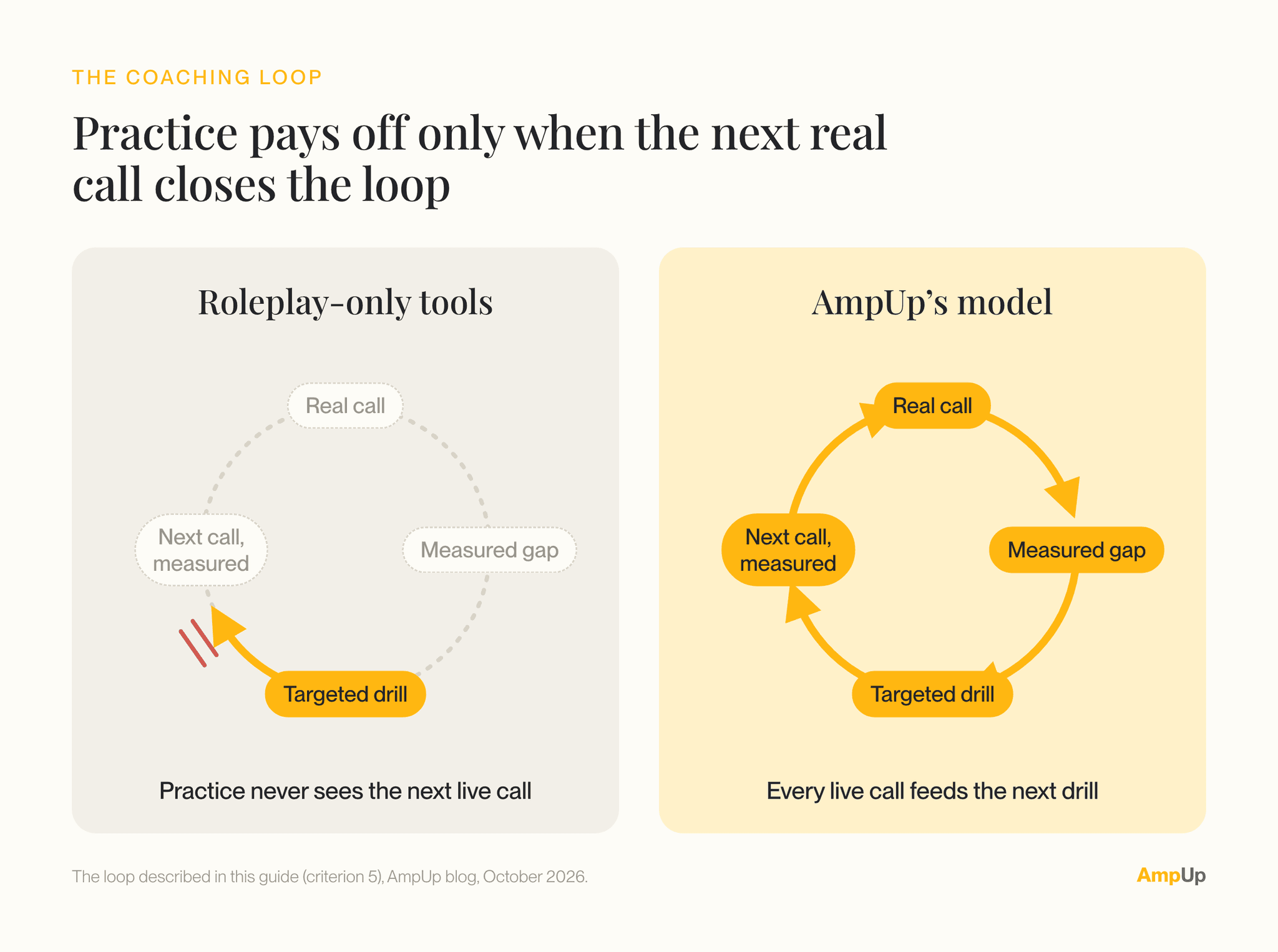
This is the argument AmpUp makes, and I’ll say it plainly so you can check it against everything below: roleplays built from your own lost calls, feedback shaped to each rep, practice delivered inside the tools reps already run. Amit wrote about the gap between top reps and everyone else in the predictability engine; for why generic scenarios fail, see why generic roleplay scripts don’t work. Our AI sales roleplay page shows the loop in the product.
Cold call training software powered by AI: 8 tools compared
Last checked October 2026. Each tool is described from its own public material; follow the links and check again before you buy, because this category changes monthly. None of the vendors below publish list prices as of this check, so every price is “ask sales.”
| Tool | What it is, in its own words | Practice built from | Feedback | Pricing (public) |
|---|---|---|---|---|
| AmpUp | Coaching and practice layer on top of your call recorder and CRM. Roleplays built from your team’s real deals and lost calls, pre-call briefs, per-rep coaching. | Your own calls and deals | Per rep, tied to behaviors that move deals in your data | Not listed; book a demo |
| Hyperbound | ”Roleplay with realistic AI buyers, built around your sales process.” Practice (roleplay) and Perform (scores recorded calls). | Personas you configure, or built from your top reps’ calls; Perform scores real calls | Scorecard with written explanations per item, timestamped quotes | Free, Practice, Perform tiers; priced per user, no figures published |
| Second Nature | ”Virtual pitch partner” that holds a conversation, scores the rep. Named Cold Call, Discovery Call and Objection Handling formats. | Scenarios you build; SCORM and LTI for any LMS | Scoring, manager insights | Not listed; book a demo |
| Quantified | AI roleplay and certification built for life sciences and regulated industries. Personas of HCPs, payers, formulary committees. | Your approved materials; white-glove build included | Scored against your criteria and exemplars; compliance checks | Not listed; get a demo |
| Nooks | Dialer-first revenue platform with an AI Coaching product. “Automatically create custom AI personas that mimic your actual prospects based on real calls.” | Real calls recorded in Nooks | Auto-scored calls, instant roleplay feedback, live battlecards | Custom quote |
| Orum | Parallel dialer (“connects the rep only when someone answers”) with a Coach layer that listens to every call and can run practice sessions. | Your scorecards; building practice from your own calls is not advertised | AI scorecards, coaching portals | Launch and Ascend plans, AI Coaching add-on, per user billed annually; no figures published |
| Gong Enable | Enablement inside Gong. AI Trainer “builds realistic role-play scenarios from your actual sales calls.” | Gong calls and snippets you link to a scenario | Scored by Gong’s AI call reviewer and a chosen scorecard | Not listed; demos and pilots |
| Salesloft | Conversation intelligence inside the Salesloft platform: records and scores calls, real-time coaching cards on live calls. | No native roleplay advertised; scores your live calls | Automatic call scores, coachable moments become tasks | Not listed |
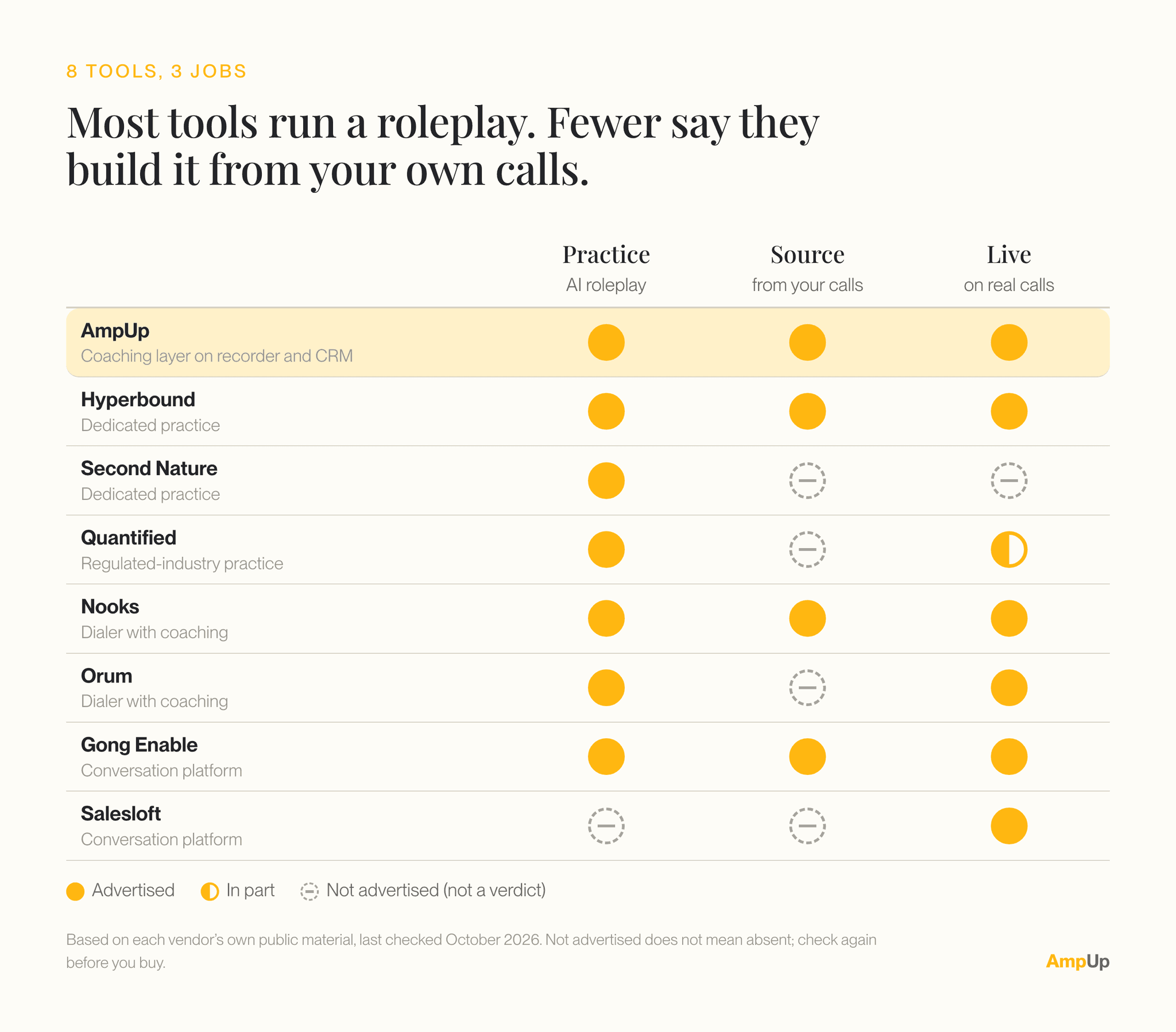
A few notes on the table.
Gong and Salesloft are the “you may already own this” entries. If your team records calls in one of them, test the built-in practice before adding a vendor. The question to ask is the per-rep one: does the roleplay change based on what this rep did on their last ten calls, or does the whole floor get the same scenario?
Quantified is here because the “AI speech coach” query pulls it in, but it is built for pharma and regulated field teams and says so.
Hyperbound and Second Nature are the dedicated practice tools and the most direct alternatives to AmpUp for a B2B team. We keep a dated comparison for each: AmpUp vs Hyperbound and AmpUp vs Second Nature. Both run strong roleplays. Hyperbound now advertises personas built from your top reps’ calls; Second Nature’s public pages describe scenarios you build. The question to put to either is the per-rep one above: is the next drill built from what this rep did on their last call?
What an AI speech coach should hear on a cold call
“AI feedback” is on every box. Here is how to tell the useful kind from the kind that produces a 78% and a shrug.
Useful feedback names a moment. “At 0:41 the buyer said ‘send me an email’ and you agreed. Your top reps answer that with one question first: ‘Happy to. So I send the right thing, what’s the one problem you’d want it to address?’” That is coachable. “Objection handling: 6/10” is not.
Useful feedback hears delivery: pacing on the opener versus the rest of the call, talk ratio, the silence after a hard objection, filler words, and whether the rep’s tone flattened when challenged.
Useful feedback is relative to this rep. A rep who cut their opener from 40 seconds to 18 this week deserves to hear that, even if the call still ended in a no.
And useful feedback produces a next drill, not a report: the next roleplay, built around the thing that went wrong, assigned where the rep will see it. Amit covered the measurement side, including why completions and quiz scores prove nothing, in how to prove your sales training worked.
AI mock calls for new hires using Sandler techniques: does it work?
Yes, with a condition: the roleplay has to know the methodology, not just the vocabulary.
Sandler’s cold-call structure is specific (our Sandler selling system explainer covers the whole method). An up-front contract at the top of the call sets purpose, time, the prospect’s agenda, your agenda and the outcome (including that a “no” is a fine outcome). Then the pain funnel, Sandler’s sequence of questions that moves from “tell me more about that” through “how long has that been a problem” and “what have you tried” to “how much do you think that has cost you” and “how do you feel about that”. Sandler’s own line is that the pain step isn’t complete until the buyer puts a monetary cost on the problem.
A generic AI buyer will happily let a rep skip the up-front contract, jump to pitching after the first “we’ve got some challenges there”, and still award a decent score because the rep “handled the objection”. A methodology-aware roleplay does the opposite: the AI buyer withholds pain until it is asked for properly, and the scorecard checks whether the contract was set, how deep the funnel went, and whether the rep got to a cost before proposing a next step.
So when you evaluate “Sandler mock calls”, ask three questions. Can the scorecard be built around the Sandler steps, in your words? Can the buyer persona reward funnel discipline and punish premature pitching? And can the scenario be seeded with your talking points and your real objections, so the new hire practices your Sandler and not a textbook version?
How to build a cold calling training program for new hires: a 30-day plan
Here is a 30-day program I’d run for a new SDR or AE cohort, with Blue Sheet prep, objection drills and recorded mock calls built in. It assumes an AI practice tool; without one, the manager does the job and does it less often.
Week 1: Listen, then set the contract.
- Days 1 to 3: each new hire listens to ten recorded cold calls from your own team, five won (meeting booked) and five lost. They write down every objection and how it was answered.
- Days 3 to 5: up-front contract and opener drills. Ten mock calls a day, each stopped after 30 seconds. The only thing scored is whether the rep set purpose, time, agenda and outcome, and sounded like a person doing it. Record all of them.
- End of week: a 15-minute debrief per rep on their recordings. Pacing and tone only. Nobody pitches yet.
Week 2: Pain funnel, every day.
- Daily: five full mock calls against an AI buyer who will not volunteer pain. The scorecard checks funnel depth: did the rep get to “how long”, “what have you tried” and a cost before proposing anything?
- Drill the eight Sandler funnel questions until the rep can ask them in their own words. Reading them off a sheet is audible on a phone.
- Mid-week: the AI buyer leads with the three objections that appeared most in the week-1 listening exercise.
- The rep reviews their own recordings before the manager does; self-diagnosis sticks better than being told.
Week 3: Blue Sheet prep and the objection gauntlet.
- For reps working larger accounts, introduce the Blue Sheet, the planning sheet Miller Heiman introduced in 1978 for its Strategic Selling method (now Korn Ferry’s), as the pre-call prep. The rep writes down the single sales objective, the buying influences and each one’s role, the win-results each wants, the strengths and red flags, and the action plan. A cold call into an enterprise account is a research call for the Blue Sheet as much as a booking call. The rep fills one in before each mock and updates it after.
- Objection gauntlet: ten mock calls a day, each built from a real lost call, each with a different buyer who beat one of your reps. “We already have a vendor.” “Send me an email.” “Not a priority this quarter.” The rep’s own five weakest objections, from their week-2 scores, get double weight.
- Pre-call briefs begin: before each mock, one paragraph on who the buyer is, what they care about and the likely objection. This habit carries into live calls; our meeting prep page shows how we automate it.
Week 4: Live calls, with the loop closed.
- Reps go live on real leads, with a manager or peer listening to a sample.
- Every live call is recorded and scored against the scorecard they practiced on. Any call that misses a step generates the next day’s drill, built from that call.
- Friday: review the 30-day arc per rep. Opener length, funnel depth, objection recovery rate and talk ratio, week 1 versus week 4. That is the ramp report. Meetings booked will follow; the behaviors are the leading indicator.
One rule across all four weeks: keep every mock call, because a rep hearing their own week-1 call in week 4 is the most persuasive coaching you will ever deliver.
Frequently asked questions
What should AI feedback on a cold call cover? Delivery (pacing, talk ratio, filler words, tone under pressure, the pause after an objection) and content (whether the opener earned time, whether the rep asked before pitching, how each objection was handled against how your best reps handle it, whether a next step was agreed). Good feedback names the timestamp and the better alternative.
How long should a cold-call training program for new hires run? Thirty days is a workable floor: a week on openers and the up-front contract, a week on the pain funnel, a week on prep and the hardest objections, a week live with every call scored. It should not end there; the point of scoring live calls is that practice keeps being assigned from what the rep actually does.

Book a demo with us
See how AmpUp turns every call into a coaching opportunity.
Written by

Rahul Goel
Co-Founder & Head of AI & Growth, AmpUp
Rahul is the co-founder of AmpUp and former Lead for Tool Calling at Gemini. He brings deep expertise in AI systems, reasoning, and context engineering to build the next generation of sales intelligence platforms.
Stay up to date with AmpUp
Follow AmpUp on LinkedInFollow us on LinkedIn for the latest on AI-powered revenue intelligence.