Paper · November 2026
Enterprise Brain: Outcome-Learned Agent Memory
Rahul Balakavi, Saakshi Singhal, Rahul Goel, Amit Prakash
AmpUp AI · research@ampup.ai
Abstract
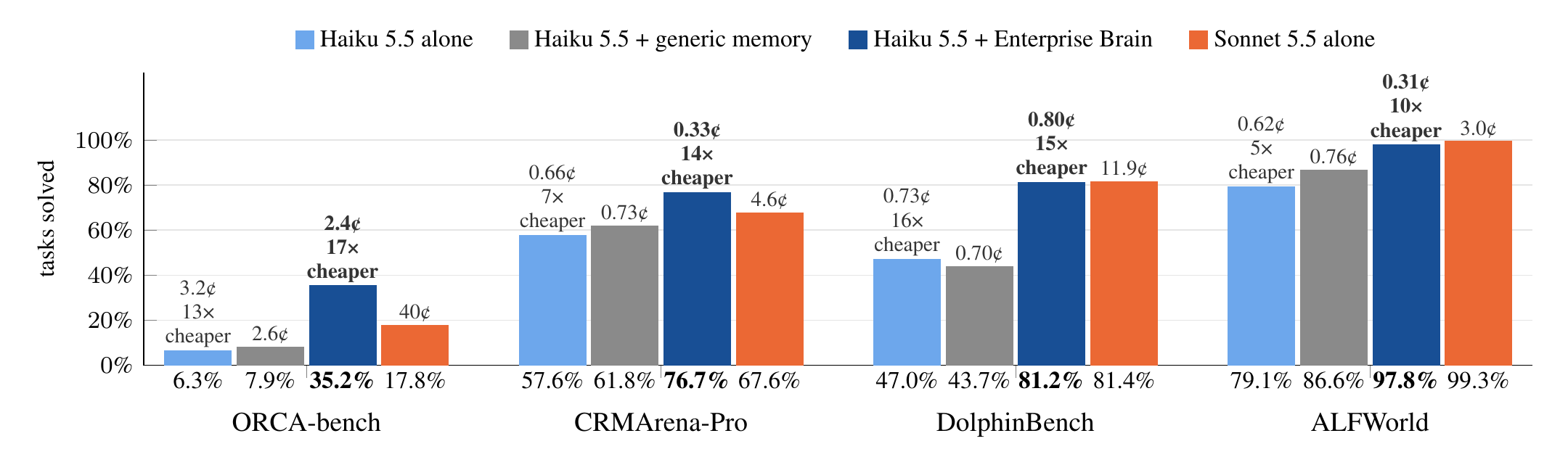
We present Enterprise Brain, a memory that lets a small agent recover a large model's performance without changing its weights. Enterprise Brain keeps two kinds of memory: a temporal memory of facts extracted from the organization's sources, each dated and cited, and a procedural memory of how the work is done. Procedural memory starts from skills extracted from the organization's knowledge base and grows with advice learned from the agent's own graded traces. A stronger model groups the agent's past runs into situations, the kinds of work the agent repeats, and writes advice for each situation from the runs that went right and the runs that went wrong. Because Enterprise Brain learns the advice from the organization's own work, the advice is domain-specific: it records conventions of the organization's systems and graders that are not captured by general models. The advice further improves by hill climbing. On public benchmarks across four domains, Enterprise Brain lets a cheap model (Claude Haiku 5.5) surpass or close most of the gap to an expensive one (Claude Sonnet 5.5), at a fraction of the cost. While Enterprise Brain shows significant gains on benchmarks with repeated tasks, it does not degrade performance on benchmarks with fewer repeated tasks.
Cite
@misc{balakavi2026enterprisebrain,
  title = {Enterprise Brain: Outcome-Learned Agent Memory},
  author = {Rahul Balakavi and Saakshi Singhal and Rahul Goel and Amit Prakash},
  year = {2026},
  publisher = {AmpUp AI},
  url = {https://www.ampup.ai/research/enterprise-brain}
}