The 45-Minute Playbook Transfer
How high-velocity sales teams turn Monday morning wins into afternoon weapons, and why the gap between your top performers and everyone else is costing you $618K per rep, per year.

A $878K Knowledge Gap
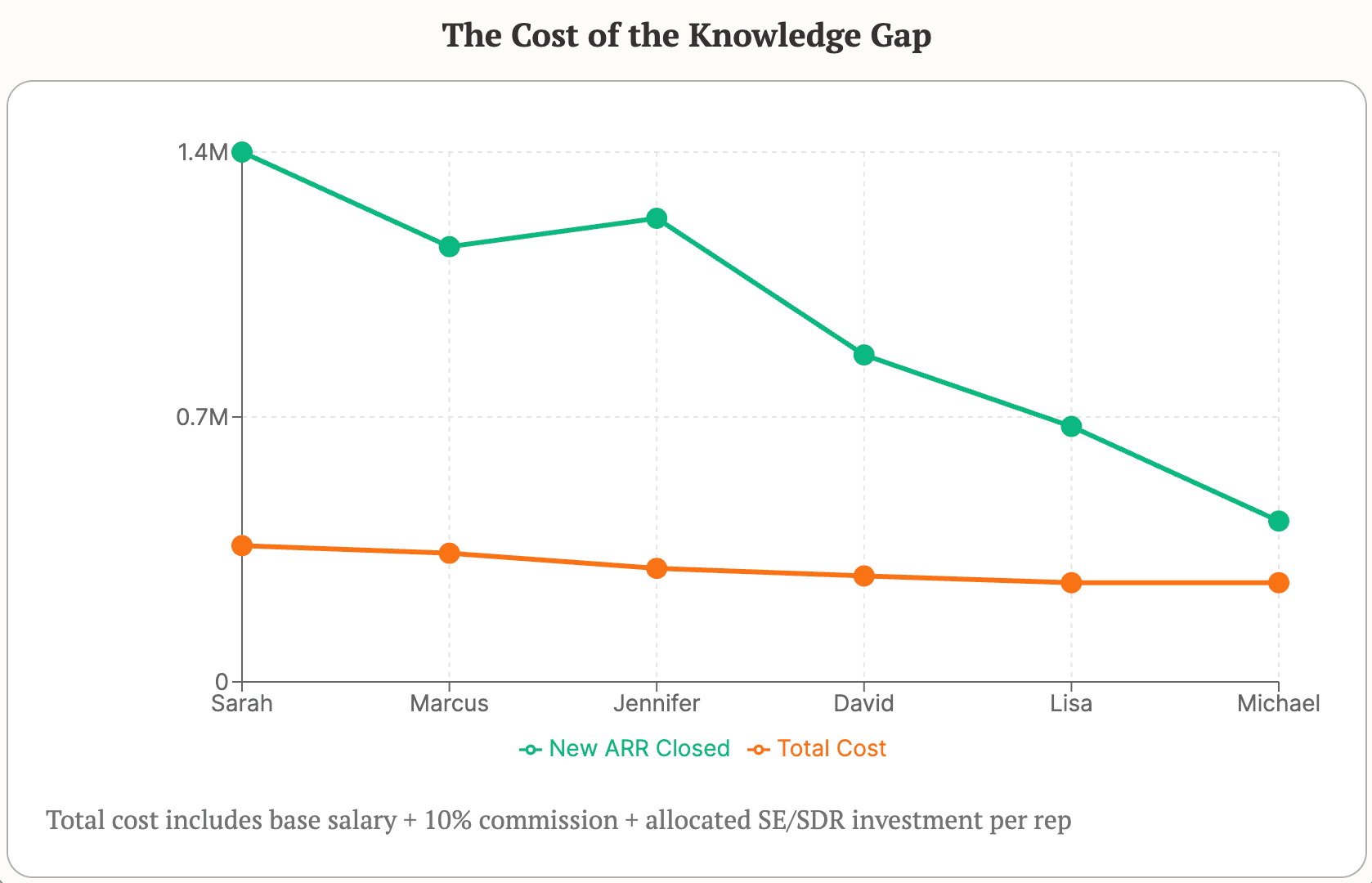
Sarah closed $1.4M in new ARR last year. She excels at discovery, value articulation, and closing. She navigates pricing objections like a chess master. When a supply chain VP asks about ROI, she pivots to margin leakage. When a fintech founder questions timing, she reframes around competitive displacement.
Marcus closed $425K in new ARR last year. Same manager. Same Slack channel. Same product. But look at his competency matrix, he’s “Needs Development” on discovery and objection handling. The exact skills where deals are won or lost.
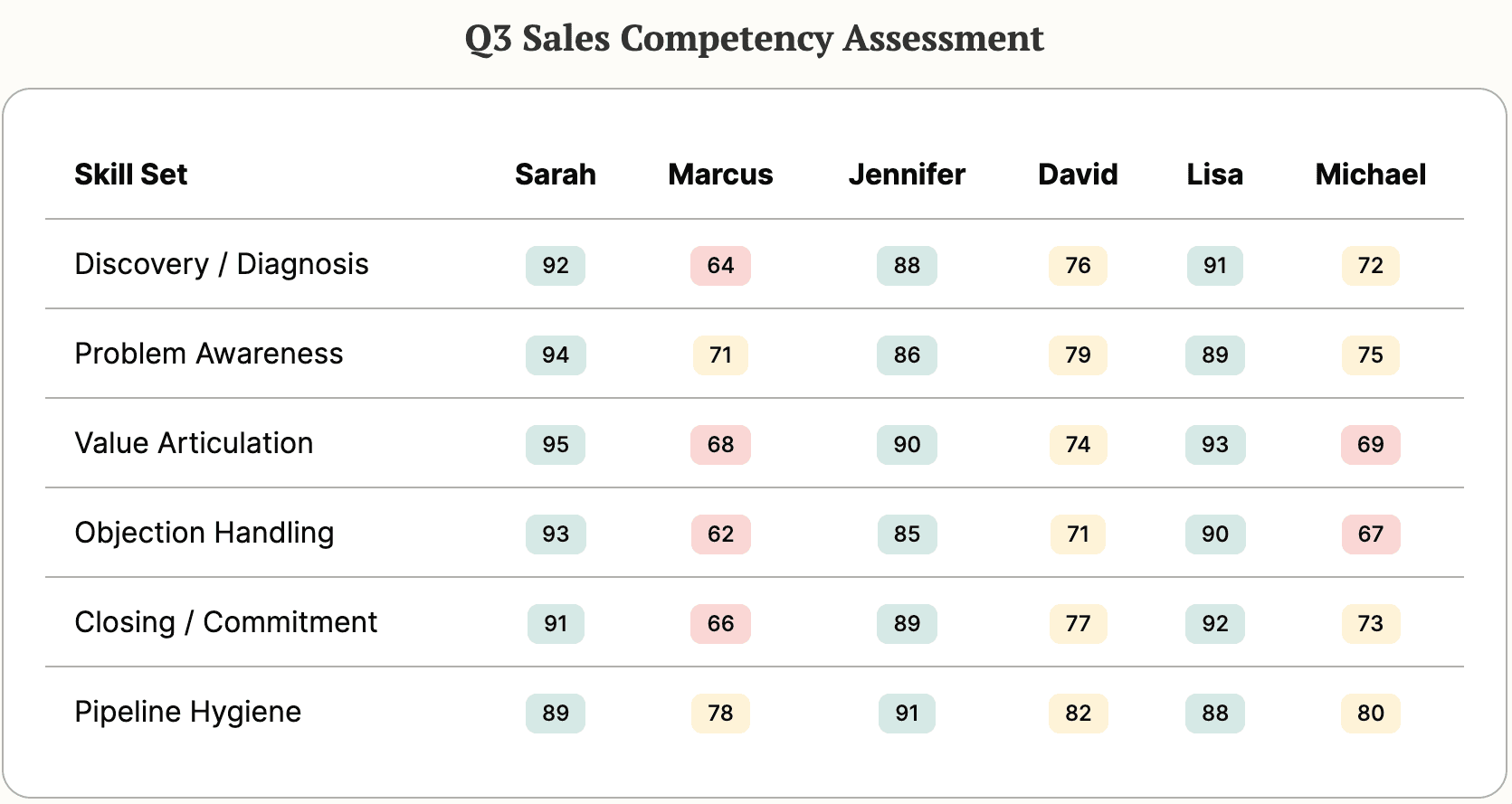
Look at Sarah’s column. She’s mastered value articulation. She excels at discovery and closing. When she takes a call from a qualified lead, you already know it’s going to advance. She closed $1.4M in new ARR last year.
Now look at Marcus. He struggles with discovery and objection handling, both “Needs Development.” He gets “friend-zoned” by prospects who like him but don’t buy. He closed $425K in new ARR last year.
They report to the same manager. They sit in the same Slack channel. They sell the same product.
Sarah’s higher performance means she costs more (higher commission payout), but her returns scale much faster than her costs.
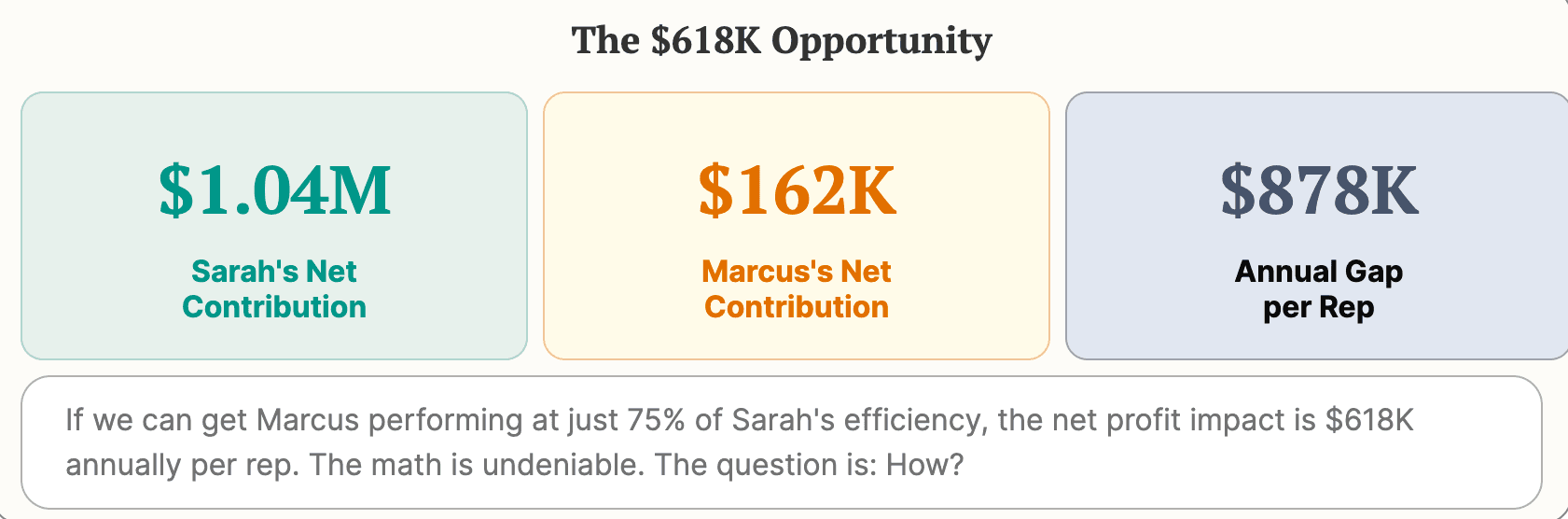
If we can get Marcus performing at just 75% of Sarah’s efficiency, the net profit impact is $618K annually per rep. The math is undeniable. The question is: How?
From 18 Months to 45 Minutes
Here’s what changed.
Most Sales Leaders look at that matrix and prescribe “Objection Handling Training” for Marcus. But if you dig into the call data, you see something different.
Sarah’s last three deals were a Supply Chain company, a Fintech startup, and a Media company. Marcus had similar buyers. But Sarah connects analytics to vertical-specific value. Marcus pitches features.
When Sarah talks to a supply chain VP, she discusses price arbitrage and margin optimization. To a media company’s CDO, she focuses on audience segmentation and content ROI. It took her 18 months to build these playbooks through trial and error.
Marcus isn’t lazy. He sits through the same trainings. But when he’s live on a call with a Supply Chain VP, he doesn’t have Sarah’s 18 months of context. He defaults to safety: “Our platform has powerful analytics.”
Monday, 9:15 AM: Sarah is on a call with a supply chain VP. When they push back on pricing, she pivots: “I understand. But let me ask you this, how much revenue are you losing monthly to pricing inefficiencies you can’t see right now? Based on similar companies, it’s typically 2-3% of top line.”
9:16 AM: The system recognizes this isn’t just a good answer, it’s a pattern match. It tags the moment, extracts the reframe, and maps it to the “Timing Objection + Supply Chain” category. It doesn’t just record the call; it isolates the winning variable.
1:45 PM: Marcus has a Supply Chain call at 2:30 PM. Usually, he would go in nervous, knowing he struggles with this buyer persona. He might stick to the script to be safe.
Here is where we solve what we call the “Empathy Gap.”
Instead of letting Marcus spiral, the system acts as a pre-game batting cage with micro-roleplays based on Sarah’s win from this morning:
Practice anytime
Coach: “Marcus, you have a Supply Chain VP coming up. Sarah faced a pricing objection with this exact persona this morning. She won by pivoting to ‘Margin Leakage.’
Instead try: ‘If you wait 6 months, what is the cost of that delay in missed margin?’”
Marcus rehearses it twice. He stumbles once, feels the awkwardness in private, and then gets it right. He enters the call with muscle memory, not just a cheat sheet.
This is the Empathy Gap in action: Marcus can’t just read about Sarah’s play, he needs to feel the awkwardness in private, work through it, and build the emotional confidence to deploy it under pressure.
2:30 PM: During the call, the prospect hits the same wall. “We need to think about it.”
Because Marcus practiced the specific play 45 minutes ago, he doesn’t freeze. He doesn’t need a teleprompter or a real-time nudge. He simply asks the question he just rehearsed.
The prospect pauses, thinks, and says, “That’s a fair point. We are probably losing about $150k a month.”
The deal advances. Marcus didn’t just save the call; he internalized a playbook that took Sarah 18 months to perfect. His baseline competency just jumped forward overnight.
Why This Actually Matters: The Genius Silo
The old way of solving this was “Enablement.” Interview Sarah, write a PDF case study, and present it to the team next month. But that approach misses what we call the “Genius Silo”, where knowledge transfer becomes trapped in top performers while the rest of the team struggles with the same challenges.
But the battlefield is redrawn every morning. By the time that PDF is written, the market has shifted again. Today’s sales teams don’t have a “knowledge” problem; they have a latency problem.
The Phenomenon
This is the Genius Silo. Sarah cracked the code, but that knowledge died in a Gong recording nobody watched. Marcus sits ten feet away, failing on the exact same objection Sarah conquered yesterday.
The winners of the next decade won’t be the teams with the best individual closers. They will be the teams with the highest Organizational Learning Velocity, the speed at which they can extract a win from Sarah’s brain and upload it to Marcus’s confidence.
What High-Velocity Learning Unlocks
This approach solves a second major issue in modern sales: Framework Fatigue.
We all use frameworks. MEDDPICC, SPIN, Three Whys. But under pressure, reps use them as checklists. “Champion identified: ✓.” They treat it as compliance work, not critical thinking.
Why doesn’t Marcus ask the “Third Why”? It’s fear. Asking the deep strategic question requires the confidence that you can handle the answer.
By giving Marcus the “Expert Context” (Sarah’s playbook) before the call, we remove the fear. We enable him to use the framework as a tool for strategic thinking, rather than a form to fill out.
When Marcus rehearses the margin leakage question, he’s not just memorizing words. He’s building confidence. He’s internalizing the vertical logic. He’s experiencing what Sarah experienced after 18 months of trial and error, but in 45 minutes.
The Shift
From: “I need to remember to ask about the champion” (checklist thinking)
To: “I understand this buyer’s pain point and can confidently explore it” (strategic thinking)
Competence isn’t just about what you know. It’s about having the confidence to apply it under pressure. That’s what changes when the system gives Marcus the exact play he needs, lets him practice it in private, and then deploys it in the moment where it matters.
Velocity as a Competitive Advantage
Most sales organizations measure lag indicators: deals closed, revenue booked, quota attainment. These are outputs of learning that happened months ago.
The teams that win measure learning velocity: How fast can we identify what’s working? How fast can we teach it? How fast can reps apply it with confidence?
When Sarah closes a deal using a new reframe at 9:15 AM, and Marcus uses that same reframe successfully at 2:30 PM, you’ve compressed an 18-month learning cycle into 5 hours. This is the power of sales onboarding that’s connected to real patterns. Do that across a team of 50 reps, across dozens of scenarios per quarter, and you’ve fundamentally changed your sales capacity.
You’re no longer limited by how fast you can hire and train new Sarahs. You’re multiplying Sarah’s impact across every rep who faces a similar situation, in real time.
A Final Thought
Every sales organization has Sarahs and Marcuses. The question isn’t whether the knowledge gap exists, it’s whether you have the system to close it before your competitors do.
If you’re curious how this works in practice, how the system recognizes patterns, generates micro-roleplays, and integrates with your existing stack (Gong, Chorus, Salesforce, HubSpot), I’d be happy to walk you through it.
Book a Demo with AmpUp
Ready to see how AmpUp can transform your sales team? Schedule a demo with AmpUp and discover how AI-powered sales coaching delivers measurable results.
Frequently Asked Questions
Q: How can we compress an 18-month learning curve into 45 minutes?
By focusing on pattern-matching instead of generic training. When your top performer closes a deal using a specific reframe, the system extracts that winning moment and creates a micro-roleplay for other reps facing the same buyer persona. AmpUp identifies these patterns automatically from your call recordings and CRM, so the context is always real and relevant.
Q: What’s the difference between this and traditional sales enablement?
Traditional enablement is centralized and delayed: interview your best rep, write a PDF, present it next month. By then, the market has shifted and the playbook is outdated. AmpUp creates learning in real time. Monday morning, Sarah wins a deal. By 1:45 PM, Marcus has practiced that exact play before his own call. Latency is everything.
Q: How do we know this actually changes behavior, not just helps reps memorize scripts?
The Empathy Gap is critical, reps need to feel the awkwardness in private before deploying the play under pressure. That’s why micro-roleplays work where scripts fail. But more importantly, AmpUp measures whether behavior actually changed and whether that change improved outcomes. You see lift in discovery quality, objection handling, and deal velocity, not just completion rates.
Q: Can this work for our vertical-specific playbooks?
Yes. The system learns from every call, so it extracts playbooks specific to your buyer personas, industries, and competitive situations. Sarah’s playbook for supply chain VPs becomes a training resource for every rep who faces similar buyers. Your organizational learning compounds instead of staying trapped in top performers’ heads.

Book a demo with us
See how AmpUp turns every call into a coaching opportunity.
Written by

Amit Prakash
Founder & CEO, AmpUp
Amit is the founder and CEO of AmpUp. Previously, he built ThoughtSpot from zero to over $1B in valuation, leading sales and customer success. He's passionate about using AI to eliminate execution variance in sales teams and make every rep perform like the top 10%.
Stay up to date with AmpUp
Follow AmpUp on LinkedInFollow us on LinkedIn for the latest on AI-powered revenue intelligence.