At $1B and above, the market does most of the visible work. A good year lifts every book, and the organic growth rate hides inside the headline number. Large firms now say organic growth is the priority. The firms that actually deliver it share a pattern, and it is an operating pattern, not a product. Here is that pattern as we read the research, what those firms measure, and what they leave alone.
93% of billion-dollar RIAs rank referrals as a top growth strategy (Cerulli). The ones that still grow organically run referrals as a managed channel. They give growth a named owner, work centers of influence on a schedule, cover the next generation and held-away assets, and measure the path from the ask to the assets.
- AUM growth hides the organic rate: the median RIA grew regulatory assets 14.5% in fiscal 2025 but added just 2.1% to its client count, per Paithos Research.
- Referrals are the main channel, yet advisors spend only about 7% of their time on business development (Cerulli), under three hours of a 40-hour week.
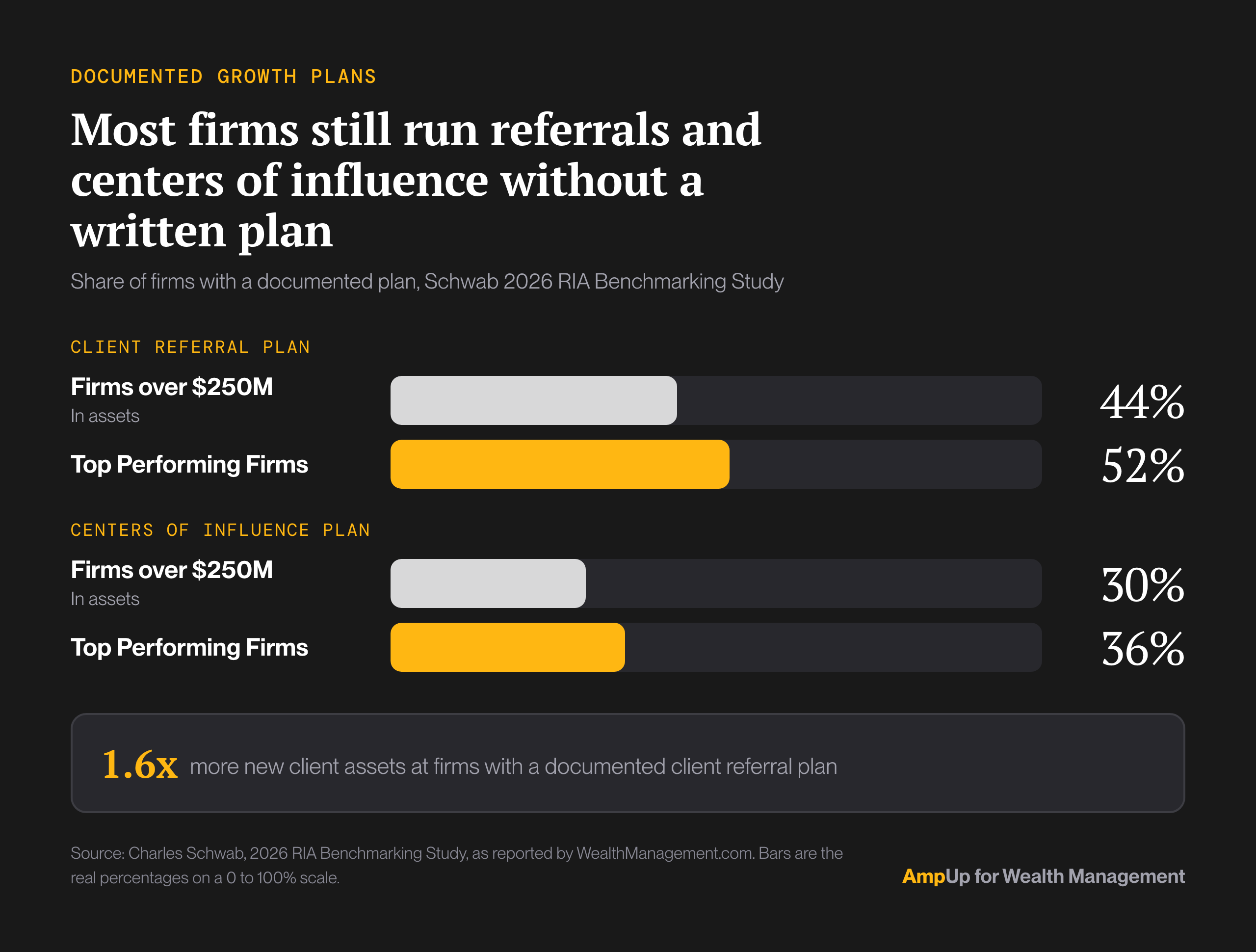
- Documentation separates firms. Schwab's 2026 study found firms with a client referral plan generated 1.6x more new client assets, and only 44% of firms over $250M have one.
- Our synthesis of the research is four plays: an owned referral channel, a deliberate centers of influence program, next-generation and held-away coverage, and instrumentation.
- Broker-dealer affiliated and hybrid practices run the same plays, but growth software has to fit their supervision and review process first.
Do billion-dollar RIAs still grow organically?
Some do, and most say they want to. Cerulli research reported by InvestmentNews in November 2025 found 67% of billion-dollar RIA executives name organic growth a top strategic priority, against 50% who prioritize M&A. The same research found 83% of billion-dollar RIAs cite a lack of advisor time as a key constraint on organic growth.
The benchmark numbers explain the urgency. In Schwab's 2026 RIA Benchmarking Study, covering 2025, median net organic growth was 4.8% for firms over $250M. Schwab's Top Performing Firms, the top 20% of its Firm Performance Index, grew organically at 12.9%. The gap between those two figures is an operating gap, and what a good organic growth rate looks like covers the arithmetic behind both.
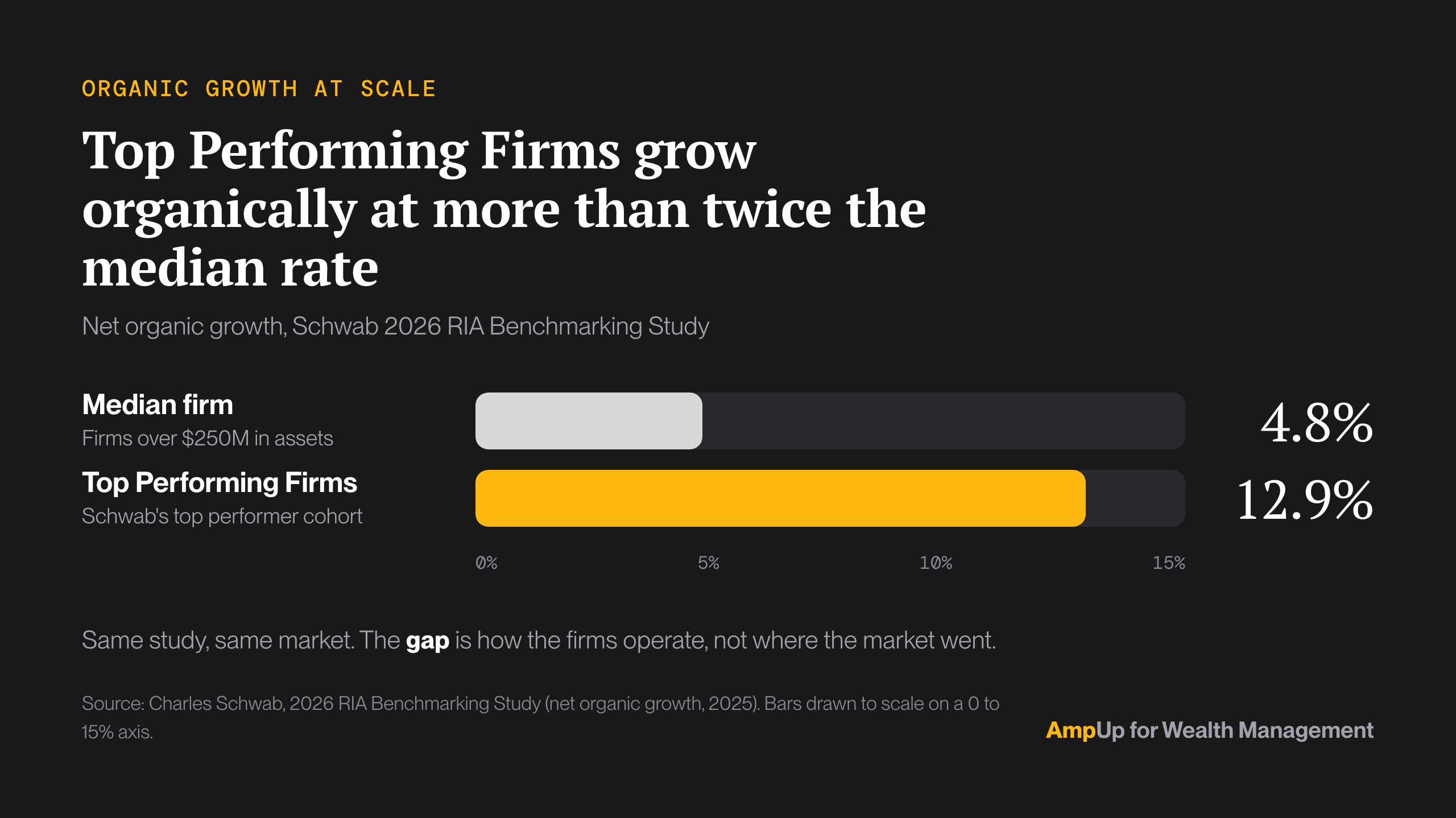
Asset growth alone hides the problem. Paithos Research's analysis of Form ADV filings, reported by InvestmentNews, found the median RIA grew regulatory assets 14.5% in fiscal 2025 while its client count rose just 2.1%. A large firm can post a strong AUM year and add very few households.
Who owns organic growth at a large firm?
In our reading of the research, at the firms that grow, one person does. The title varies: chief growth officer, head of business development, or a COO with growth in the mandate. What matters is that one person answers for the organic growth rate, and that the rate is reported separately from market movement.
The rhythm we recommend: that owner reviews activity weekly and flows monthly, not once a quarter:
- Asks made and introductions opened, by team, to see where rehearsal support helps.
- Introductions in motion, from first mention to funded account.
- Center of influence activity: meetings held, cases shared, introductions received.
- Next-generation contacts and held-away assets identified in client conversations.
- Net flows by source: new households, existing client additions, outflows.
With advisors spending about 7% of their time on business development, per the same Cerulli research (under three hours of a 40-hour week, by our arithmetic), the owner's first task is protecting that time and helping advisors spend it on the right households.
The four plays below are our synthesis of that research, not a framework any one study names. They are the habits the benchmark data rewards.
Play 1: How do they run referrals as a channel?
Referrals are the main source of organic growth at scale. Cerulli's research found 93% of billion-dollar RIAs rank referrals as a top organic growth strategy. Yet most firms still run the channel informally. In Schwab's 2026 study, firms with a documented client referral plan generated more new client assets than firms without one: 1.6x more, as reported by WealthManagement.com. Only 44% of firms over $250M have that plan. Even among top performers, only 52% do.
A documented plan at a large firm usually covers three things. First, when to ask: the moments in client conversations when an introduction fits, such as a life event, a compliment, or a mention of a friend's situation. Second, how to ask: language each advisor will actually say, rehearsed before the conversation. Third, follow-through: every ask is recorded and traced to an introduction or a decision to wait.
The gap the plan closes is old and well measured. Research by Advisor Impact with Schwab Advisor Services and Texas Tech University, a 2010 study, older but still widely cited, found 91% of clients comfortable referring their advisor, while only 29% had done so in the prior year. The clients are willing. The asks are not happening. Why client referrals slow down looks at the causes in detail.
Play 2: How do they work centers of influence?
Large firms treat CPAs and estate attorneys as a program, not a set of personal friendships. The documentation gap is wider here than for client referrals. Only 30% of firms over $250M have a documented plan for centers of influence, and 36% of top performers do, per Schwab's 2026 study.
A working program is simple. Each center of influence has a named relationship owner. Meetings run on a set cadence. The firm brings something useful to each meeting, such as a planning observation or a shared client question, rather than a request. Introductions in both directions are recorded. Cadence produces more than charm does, because it survives a busy quarter. Centers of influence for financial advisors sets out the program step by step.
Play 3: How do they cover the next generation and held-away assets?
Large firms treat heirs and outside assets as growth, not only as retention. Cerulli projects about $124 trillion in wealth will transfer through 2048, with $105 trillion expected to flow to heirs, per its December 2024 release. For a firm with an older book, the next generation is both the largest outflow risk and the largest source of new households.
The practice is to meet adult children before the transfer, not after it, and to notice held-away assets when clients mention them in conversation. Both depend on information that surfaces in client conversations and is easy to lose. Next-generation client retention and held-away assets without the audit feel cover each in turn.
Play 4: What do they measure beyond AUM?
Most firms measure outcomes: AUM, new households, net flows. In our reading of the research, firms that grow organically also measure the activity that produces those outcomes. The difference is the two middle numbers below.
| Measure | Where it lives | What it tells the owner |
|---|---|---|
| Net flows by source | Custodian data and CRM | The organic growth rate, separated from market movement |
| Referral moments versus asks | Client conversations | Where introductions were possible and whether advisors acted |
| Introductions in motion | CRM and conversation records | Next year's growth, before it shows in flows |
| Assets from each ask | Custodian data, traced to the ask | Which activity actually produced growth |
The middle two rows live in client conversations, which is why most firms do not have them. That is the gap AmpUp for Wealth Management works on. It reads across client conversations, surfaces the referral moments worth acting on, drafts the ask in that advisor's own voice, and keeps the growth record: which moments occurred, what the advisor said, and whether it converted. The growth owner sees referred assets by source in the Growth Office. Records stay in the CRM, and the advisor decides every ask.
Supervision matters too, and the broker-dealer section below covers it. How AmpUp handles compliance answers the diligence questions.
What growth software fits broker-dealer affiliated and hybrid advisors?
The four plays apply unchanged to broker-dealer affiliated and hybrid practices. What changes is the review layer around them. Communications on the brokerage side fall under FINRA supervision, a hybrid advisor may answer to both a broker-dealer home office and the firm's own RIA compliance, and anything an AI tool drafts for a client conversation has to fit the firm's written supervisory procedures before it reaches an advisor.
So the test for growth software in these structures is the compliance fit first and the feature list second. Four questions cover most of it:
- Is every draft a draft? The advisor should decide and say the ask, with nothing sent to a client automatically.
- Can compliance set the language rules? Approved phrasing and off-limits topics configured once, centrally, rather than policed advisor by advisor.
- Can every output be traced? A supervisor or examiner should be able to see which conversation or document produced a suggestion.
- Does it keep records where they already live? Records in the existing CRM and retention mapped to books-and-records obligations, so adopting the tool does not create a new system of record.
AmpUp for Wealth Management is built for regulated firms on those terms; how AmpUp handles compliance sets out the controls. A broker-dealer or hybrid firm should still run the tool past its own CCO and home office before advisors use it.
What do growing large firms notably not do?
- They do not report AUM growth as organic growth. Market movement is reported separately, so the organic rate is visible on its own.
- They do not confuse notetaking with growth tooling. The same Cerulli research found 70% of billion-dollar RIAs use AI for notetaking or call documentation. That saves advisor time. It does not, by itself, produce an ask.
- They do not run an annual referral campaign. A once-a-year push produces a spike and then silence. A weekly activity rhythm produces a steady flow of introductions.
- They do not hand every advisor the same talk track. Language an advisor will not say does not get said. The ask has to fit the person making it.
Frequently asked questions
How do large RIAs separate organic growth from market growth? They report net flows by source (new households, additions from existing clients, outflows) every month, separately from market movement. Paithos Research found the median RIA grew regulatory assets 14.5% in fiscal 2025 while its client count rose just 2.1%, the gap that market returns hide.
What is the main organic growth channel for billion-dollar RIAs? Referrals. Cerulli research found 93% of billion-dollar RIAs rank referrals as a top organic growth strategy. Centers of influence are a second referral channel, though only 30% of firms over $250M have a documented plan for them, per Schwab's 2026 study.
Who should own organic growth at an advisory firm? One named person, with the organic growth rate as their measure. At large firms this is often a chief growth officer, head of business development or COO. The role reviews asks and introductions weekly and flows monthly.
Does a large firm need new software to grow organically? Not first. The operating model comes first: an owner, a documented referral plan, a center of influence program and a weekly activity review. Software helps when it measures the parts of that model that live in client conversations.