The sentence usually arrives at a partner meeting: our clients say they love us, but referrals have slowed down over the last two years. Satisfaction surveys are fine. Retention is fine. And yet the new-client count is drifting down, and nobody can say when it started. Because satisfaction looks healthy, firms go looking for a service problem and never find one. The causes are almost always somewhere else, and most leave evidence in the meetings you are already holding.
Referrals rarely slow because clients are less happy. They slow because the book ages past its peak referral years, the asks quietly stop, and nobody at the firm notices either change. The diagnosis is in your client conversations, not your satisfaction scores: look at where the last 20 new clients came from, count how many asks actually happened, and listen for the moments when a client is already talking about someone who needs help.
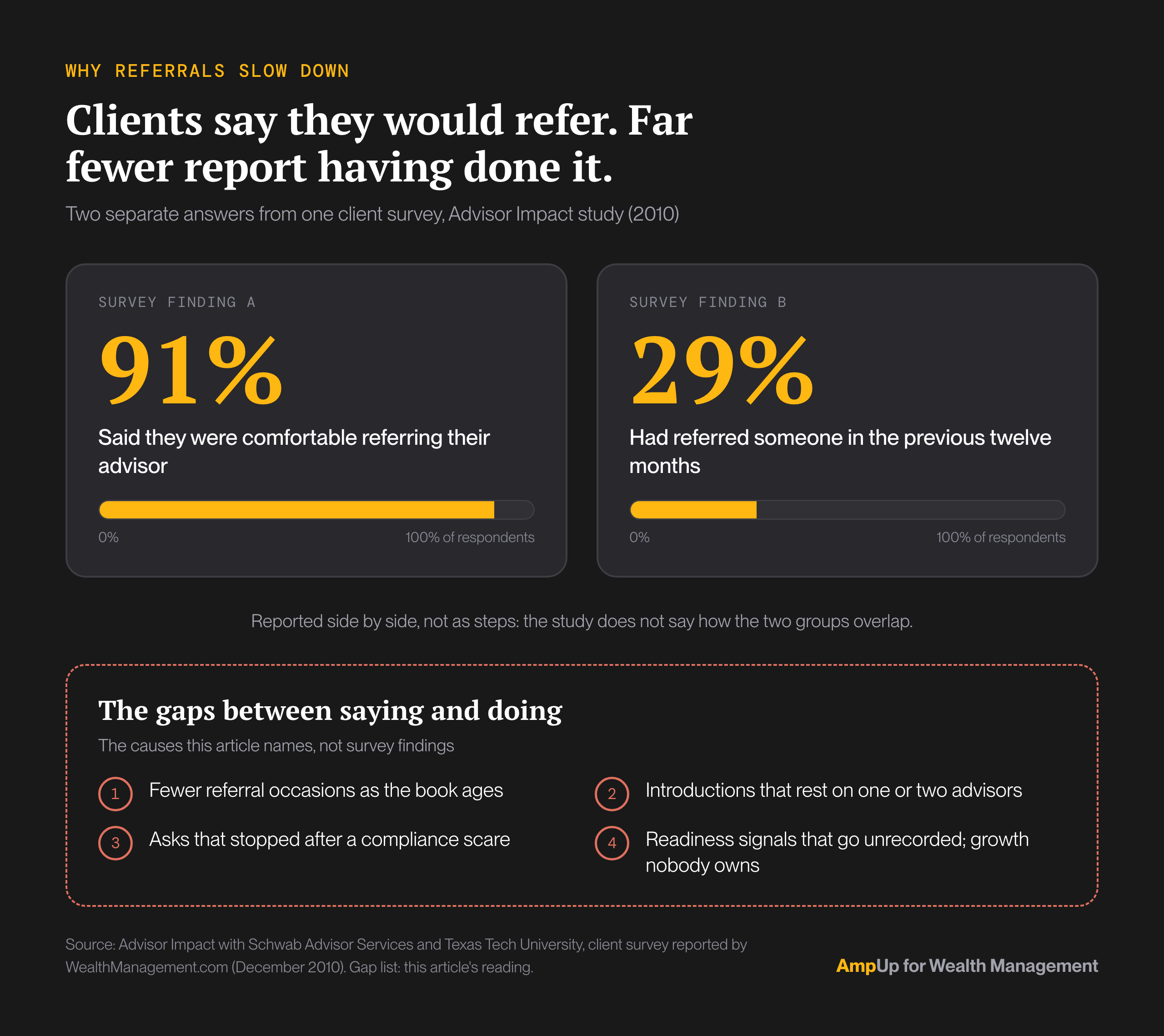
- Satisfaction is almost never the cause. In the Advisor Impact study, a 2010 survey that is still the most-cited measure of the gap, 91% of clients said they were comfortable referring, and in a separate answer 29% said they had referred someone in the prior year. The gap is a prompt problem, not a loyalty problem.
- Five causes explain most slowdowns: an aging book, dependence on one or two advisors, asks that stopped after a compliance scare, centers of influence that went quiet, and growth that nobody owned while markets carried the assets.
- The audit takes an afternoon: source the last 20 new clients, count the asks honestly, and put two questions to each advisor.
- Clients signal readiness inside ordinary meetings: a life event in someone else's life, a friend's question, unprompted praise, a complaint about another advisor, or a request for something you do not do.
- Firms that recover move from an annual campaign to a short weekly list of who is worth asking and why, with the ask traced through to the introduction.
First, rule out the myth
The instinct is to treat a referral slowdown as a satisfaction signal. If clients were really happy, the reasoning goes, they would be sending people. The evidence has pointed the other way for a long time. Research by Advisor Impact with Schwab Advisor Services and Texas Tech University, reported in 2010, found 91% of clients comfortable referring their advisor. Asked separately what they had done, 29% said they had referred someone in the previous twelve months, and 2% had referred because the advisor asked. The study reports these as separate answers and does not say how the groups overlap. Clients were far more likely to refer when a friend described a financial challenge (57%) or asked for a recommendation (48%).
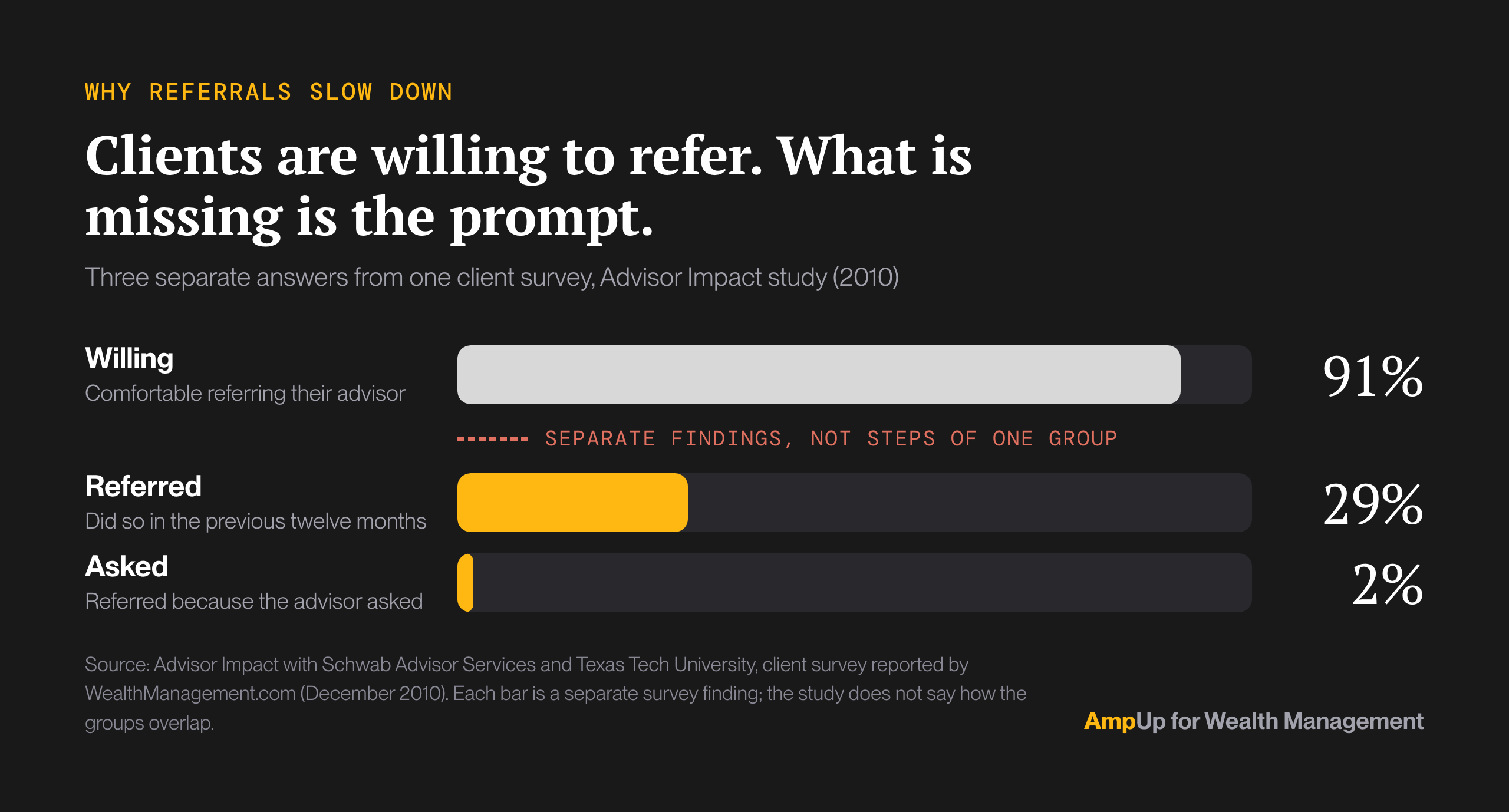
Read that as a diagnosis. Willingness is high. Action depends on a prompt: a friend's situation, a question, an ask. When referrals slow, it is the prompts that have thinned out, not the willingness. Process can fix a prompt problem. This is not a satisfaction problem.
Before anyone commissions another client survey, look at the five things that change over a two-year window.
What are the five usual causes?
1. The book aged past its peak referral years
Clients refer most during the years when their peers are making decisions: selling a business, changing jobs, inheriting, retiring. Once a client's circle has settled into retirement, those occasions become rarer. Cerulli's July 2026 research, covered by Wealth Solutions Report, put more than half of RIA clients at age 50 or older and a quarter at 60 or older, with 56% of RIA outflows in 2025 coming from income withdrawals and one-time distributions. The same shift, by our reading, also lowers the number of referral moments a book produces. Nothing went wrong; the demographics moved.
2. Referrals were concentrated in one or two people
At most firms the referral number was never a firm number. It was two advisors' numbers added together. When one of them steps back, moves to a service role, or fills their book, the firm's referral rate can fall by a third overnight, and the aggregate hides where it happened.
3. The asks stopped after a compliance scare
The SEC Marketing Rule folded referrals into the definitions of testimonial and endorsement, and the noise around its 2022 compliance date made some firms cautious about asking at all. The caution is misplaced. An advisor asking a client for an introduction, with nothing of value changing hands, is a conversation and not an advertisement. What the rule governs for a referral is compensation, adoption and the records around them, and the SEC Marketing Rule guide walks through the four questions that settle it. But where the compliance officer said be careful and nobody defined careful, advisors concluded the safest ask was no ask. Two years later the referral line reflects it.
4. Centers of influence went quiet
Cerulli's U.S. Advisor Metrics 2025 report, released in February 2026, attributes 54.2% of new clients to referrals from clients, friends and family, and 13.9% to centers of influence such as CPAs and estate attorneys. The COI share is the one that decays silently. An accountant who sent two cases a year keeps sending them only while the relationship is current: a recent joint client, a recent conversation, a recent thank-you. Many of the relationships a firm counts on were built by a founder a decade ago and not tended since. Centers of influence for financial advisors covers how the productive ones are kept.
5. Growth went unowned while markets carried the assets
For most of the last decade market returns did most of the work of growing AUM (the arithmetic is in what a good organic growth rate looks like), so nobody needed to own organic growth. Schwab's 2026 RIA Benchmarking Study found that firms with a documented client referral plan generated 1.6x more new client assets than firms without one, yet only 44% of firms over $250M in AUM had such a plan, even though client referrals have been the industry's top stated priority every year since 2023. Cerulli's July 2026 research found only 51% of RIAs proactively ask for referrals at all. A channel with no owner, no plan and no measurement does not fail loudly. It drifts.
How do you diagnose which one you have?
This is an afternoon's work. Three steps.
- Source the last 20 new clients. For each one, write down who introduced them, which advisor received the introduction, and roughly when. If 14 of 20 trace to one advisor, you have cause two. If the introducers are nearly all clients over 65, you have cause one. If no CPA or attorney appears on the list, cause four.
- Count the asks honestly. Not the referrals, the asks. How many times in the last quarter did an advisor at the firm say to a client, in some form, is there someone you think we should talk to? Most firms find the answer is close to zero and nobody had noticed, because nothing records an ask. How RIAs track and measure referral activity explains why a firm needs to count asks and openings, not just funded accounts.
- Ask each advisor two questions. First: when did you last ask a client for an introduction, and what did you say? Second: is there anything that makes you hesitate to ask? The first question tells you whether the asks are happening. The second tells you why not, and the answers cluster. Advisors say it feels like selling, or they are unsure what compliance allows, or they do not want to put a good client on the spot. Each is fixable, and none is a satisfaction problem.
What signals in a client meeting mean the client is ready to refer?
Clients refer when a friend's situation creates the occasion. Those occasions come up in review meetings all the time, in passing, and are almost never recorded. How top advisors get referrals consistently covers the habit; five of those occasions are worth listening for.
- A life event in someone else's life. My brother-in-law is selling his practice. My daughter just made partner. Our neighbors are finally retiring. The client is describing a person about to need advice.
- A friend's question. My friend was asking what we do about required distributions. Someone at the club wanted to know if we had looked at a Roth conversion. Their circle already treats them as a source of recommendations. They are one sentence away from an introduction.
- Unprompted praise with a comparison in it. Not thank you, but I wish we had done this ten years ago, or I do not understand why my sister's advisor never explained this. The client is rehearsing what they would say to that person.
- A complaint about another advisor. The client mentions a friend or family member who is frustrated, confused, or has not heard from their advisor in a year. The need is explicit and the client is already sympathetic to a change.
- A request for something outside your service. Can you recommend an estate attorney? Do you know anyone who does business valuations? The client trusts your judgment about other professionals. That is a referral moment and a center-of-influence moment in one.
Each of these surfaces in conversation and dies in the CRM. A meeting note records the portfolio discussion and the action items, rarely that the client's neighbor is retiring, and nothing turns that line into an ask three weeks later. The signals are not rare. They are unrecorded.
What do firms do about it?
Firms that reverse a slowdown make the same change: they stop treating referrals as an annual campaign and start treating them as a weekly list. The campaign version is an email to all clients, a client event, or a quarter where everyone agrees to ask more. It produces a burst, then the calendar reasserts itself. The weekly version is a short list for each advisor of which clients are worth asking this week and why, drawn from what those clients said in recent conversations, with the ask drafted in words that advisor would use and the outcome traced to an introduction and to assets. It is the difference between asking more and asking the right person at the right moment.
Three things make the weekly version hold. Someone owns the organic growth number, which is what a Growth Office is for. The readiness signals above get captured from conversations rather than relying on an advisor's memory. And the ask is counted, so the firm can see whether the behavior is happening months after the offsite energy has faded. What is a good organic growth rate for an RIA shows what the number looks like when the engine is working.
This is the job AmpUp for Wealth Management does: it reads across client conversations for referral moments like the ones above, gives each advisor a list of who is worth asking and why, drafts the ask in that advisor's own voice, and traces each ask through to the introduction. Records stay in the CRM. The advisor decides every ask. The result is a firm that can answer the question this post opened with, because it can see where the referrals went.
Frequently asked questions
Our clients say they love us but referrals have slowed. What usually causes that at an RIA? Rarely satisfaction. The usual causes are an aging book producing fewer referral occasions, dependence on one or two advisors for most introductions, asks that stopped after a compliance scare, centers of influence that went quiet, and nobody owning growth while market returns carried assets. Source the last 20 new clients and count the asks to find which one you have.
What signals in a client meeting mean the client is ready to refer someone? A life event in someone else's life, a friend's question the client relays to you, unprompted praise that compares you to another advisor, a complaint about a friend's advisor, and a request for a professional you do not provide. All five surface in ordinary review meetings and are rarely recorded.
Is it a compliance problem to ask a client for an introduction? Asking, with nothing of value changing hands, is a conversation rather than an advertisement under the SEC Marketing Rule. For referrals, the rule turns on compensation, adoption of a client's statement, and the records around both. Confirm the firm's position with your CCO once and write it down so advisors know what careful means.
How many new clients should we audit? Twenty is enough. It is small enough to source from memory and the CRM in an afternoon and large enough to show concentration by advisor, by introducer age, and by channel.
Should we run a client survey first? No. Surveys measure willingness, which the research says is already high. Measure the asks and the moments instead, since those are what changed.