
Sales Coaching
Sales Call Scorecard: Grade In-Home Sales Calls with AI
A sales call scorecard sets the standard for a good in-home appointment. AI grades every one against that standard, so you coach each rep where jobs leak.
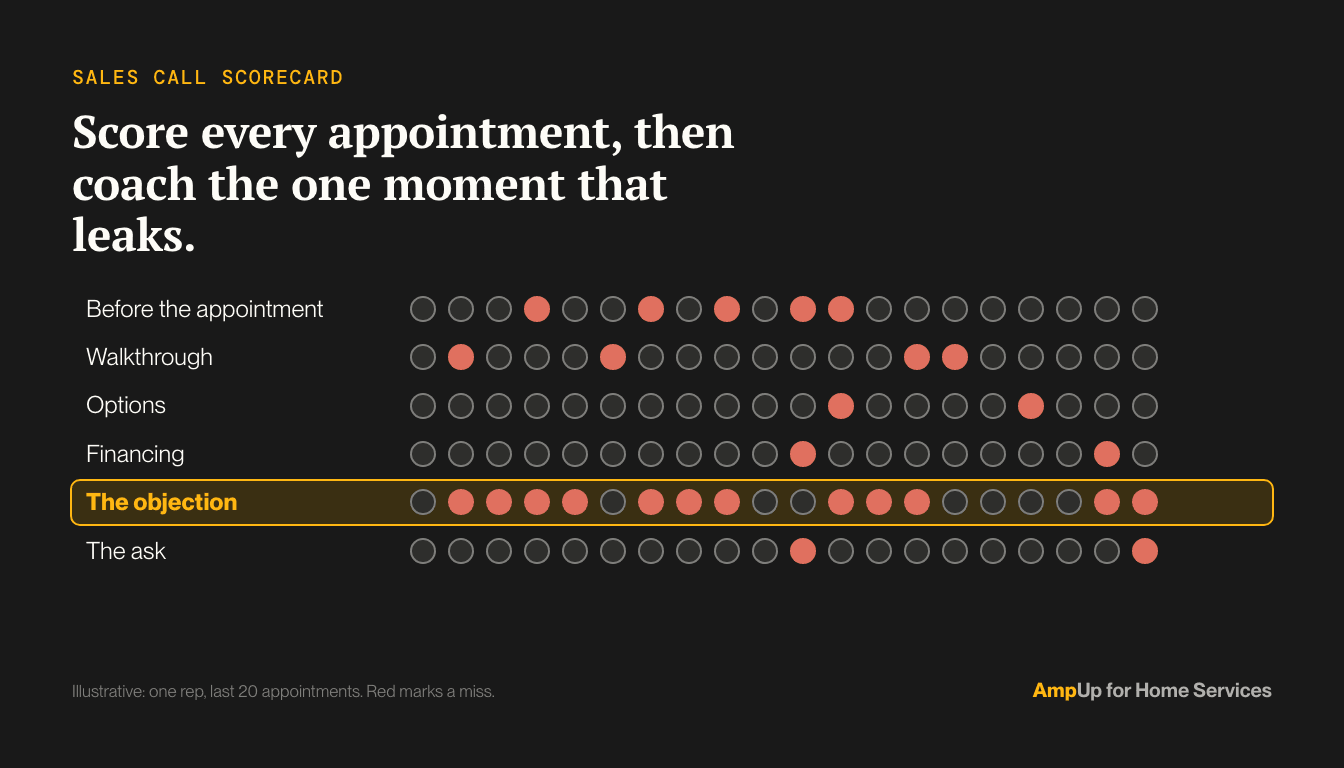
TL;DR: Should You Use a Scorecard or AI to Grade In-Home Sales Calls?
Use both. You write the scorecard: your standard for a good appointment. AI applies it to every appointment, not the handful a manager can sit through. Then coach each rep on the one moment, from their own appointments, where their jobs leak.
See how AmpUp for Home Services turns each rep's own appointments into a coaching profile and the next thing to work on.
Book a demo →What Is a Sales Call Scorecard, and What Is It Good For?
A sales call scorecard is a short list of the moments in an appointment that decide whether it becomes a job, with a plain standard for each. In home services that usually means the opening at the door, the walkthrough, how many options were presented, when financing came up, how the rep handled the objection that showed up, and whether they asked for the job.
Writing it is worth doing even if nobody ever fills one in. It forces you to say out loud what your best rep does that your newest rep does not. It rarely gets written down. Owners know it when they see it in a kitchen, and they cannot hand it to a rookie. The scorecard is the handover.
Here is a starting point for a set in-home appointment. Change the moments to match how your company sells; a technician selling inside a service call will have a shorter list with no booking call in it.
| Moment | What good looks like | What to listen for |
|---|---|---|
| Before the appointment | Rep knows the job, the home and what the homeowner said on the booking call | Does the rep repeat back the homeowner's own reason for calling in the first five minutes? |
| Walkthrough | Rep finds the problem with the homeowner, not for them | Questions about how the home is used, not only about the equipment |
| Options | More than one option, priced, explained in the homeowner's words | Count the options. One option is a yes or no question |
| Financing | Raised as a way to get the right option, before price becomes the objection | Does financing come up only after the homeowner flinches? |
| The objection | Rep asks what is behind it before answering it | Repair one more time, I need to think, I need another quote: what did the rep say next? |
| The ask | Rep asks for the job, plainly, once the homeowner has what they need to decide | Did the appointment end with a question or with a brochure? |
Keep it to six or seven moments. A scorecard with twenty lines is a training manual, and nobody scores twenty lines honestly at the end of a long day. For the order these moments usually come in, see The In-Home Consultation Framework.
Why Does a Scorecard Filled In by a Manager Fall Short?
A paper scorecard has two problems that have nothing to do with how well it is written. It sees very few appointments, and it measures the person holding the pen almost as much as the rep.
It only sees the appointments a manager can sit through
A manager who rides along can only be in one truck at a time, and much of a ride-along day goes to driving. The rep also sells differently with the manager in the truck. So the scorecard ends up describing the few good-behavior appointments the manager saw, not the many the rep ran alone. Why Ride-Alongs Don't Scale walks through the arithmetic.
It measures the grader as much as the rep
This is the part that surprises people. When people rate other people's work, a large share of the score comes from who is rating, not from the work. A study by Scullen, Mount and Goff, published in 2000 in the Journal of Applied Psychology, looked at two groups of managers (2,350 and 2,142 people) rated by seven raters each in a 360 feedback program. The rater's own tendencies accounted for 62% and 53% of the variance in the ratings. The person's actual performance accounted for 21% and 25%.
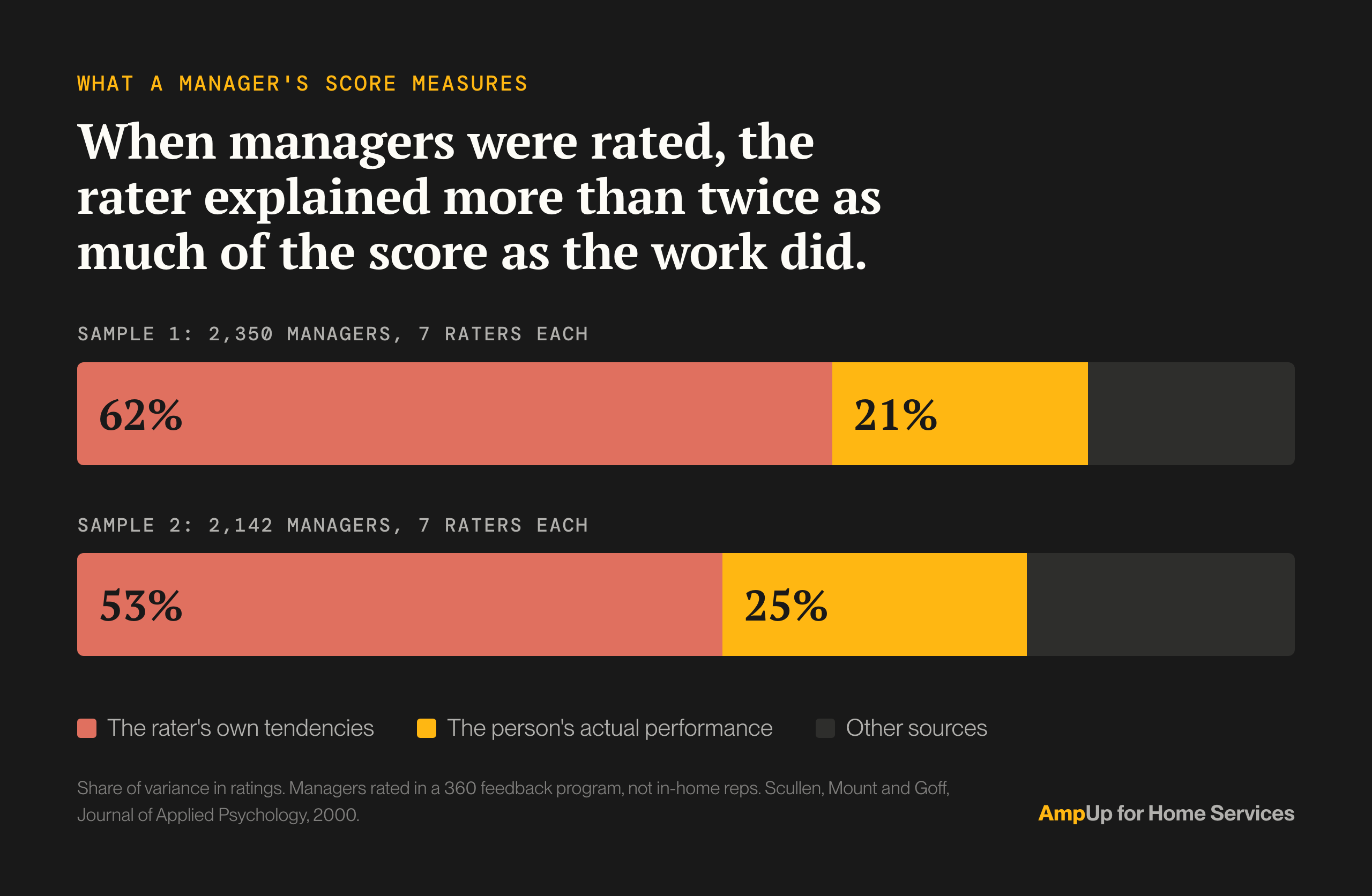
Those were managers being rated by colleagues, not in-home reps being scored on appointments, but there is no reason to think a sales manager filling in a scorecard in the truck is the exception. One manager scores hard on the close and easy on the walkthrough. Another does the opposite. So the same rep can get a different score depending on who rode along, and the rep learns more about the grader than about the appointment.
A score is not coaching
Even a fair score can make things worse. Kluger and DeNisi's 1996 review of feedback research in Psychological Bulletin pooled 607 effect sizes. Feedback helped on average, but in over a third of cases it lowered performance. Feedback did worse the more it pointed at the person and the less it pointed at the task. A rep who gets back a 3 out of 5 hears a verdict on themselves. A rep who hears the sentence they said when the homeowner mentioned repair, and a better one to try, hears a task.
What Does AI Change About Reviewing Sales Calls?
AI changes how many appointments get graded and how consistently. It does not change what a good appointment is. That still comes from you.
- Every appointment, not a sample. Once appointments are captured, the AI can go through all of them. A pattern that repeats across a rep's month of appointments is visible. A pattern that showed up in the one appointment the manager rode on is a guess.
- The same written standard, every time. The model does not get tired at 6pm, and it does not grade the rep it likes more kindly. It is not perfect (see the agreement numbers below), but it applies the same written standard to every rep.
- Close to a human grader, much faster. A 2025 study at SIGDIAL by Schiött and colleagues (ACL Anthology) compared AI grading of transcribed medical-student interviews against expert graders. The experts agreed with each other at a pooled kappa of 0.71 (kappa is a 0 to 1 measure of how often graders agree beyond chance); the best model reached 0.68. The model took under 30 seconds per transcript against about 6 minutes for a human. That was a controlled simulation, not real appointments.
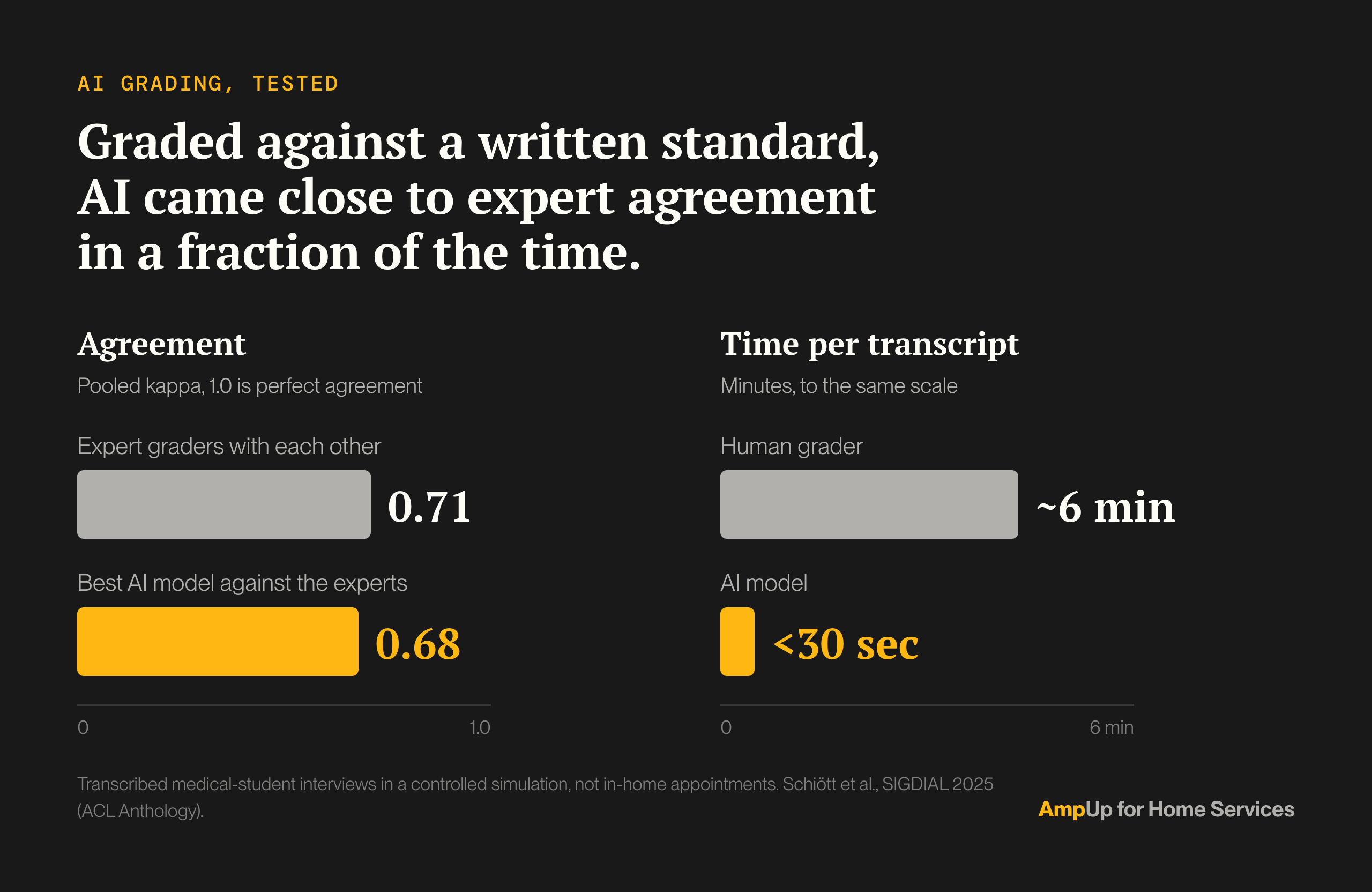
Take that study for what it is. It graded student interviews in a controlled simulation, not homeowners in a kitchen. The authors conclude that automatic grading can approach human reliability under controlled conditions. The fair reading for a home-services owner is that AI can apply a written standard about as consistently as a careful person can, at a volume no person can match. It is only as good as the standard you give it.
How Does a Paper Scorecard Compare With AI Grading?
A sales call scorecard is the written standard for a good appointment; AI review is the way that standard gets applied to every captured appointment instead of a sample. Here is how the two compare.
| What you compare | Paper or spreadsheet scorecard | AI grading against your scorecard |
|---|---|---|
| Who sets the standard | You | You |
| Appointments graded | The few a manager can attend or replay | Every captured appointment |
| Consistency | Varies by grader and by day | Applies the same written standard every time |
| What the rep gets | A score, days later | Their own moments, with what to try next |
| Risk | Becomes a form nobody fills in | Feels like surveillance unless every review ends in coaching |
How Do I Measure Each Rep's Performance Beyond Close Rate?
Close rate tells you who is losing jobs. It does not tell you where. Two reps can close at the same rate and lose their jobs in completely different places. Take a worked example, with illustrative numbers rather than a benchmark: each rep runs 20 appointments and closes 7. One presents a single option on most appointments. The other presents three, but 9 of their 13 losses end within a minute of the homeowner saying they will repair it one more time. Same close rate, different fix.
So measure the moments, per rep, over enough appointments to see a pattern:
- Option count. How many options did the rep present, on average, over the last twenty appointments?
- Financing timing. Did financing come up before or after the price objection?
- The objection that ends it. Which objection shows up in the appointments that did not close, and what did this rep say next? Objection handling training covers how to practice the answer.
- The ask. In how many appointments did the rep actually ask for the job?
- Average ticket. Is the rep closing, but closing the smallest option?
Each of those is a moment a rep can practice. Close rate is not. For a sense of where close rates usually sit, see What Is a Good Close Rate in Home Services?.
How Do I Find Out Why My Sales Reps Aren't Closing?
Look at the appointments that did not close, one rep at a time, and find the moment they have in common. Not the team's average. That rep's.
- Pull one rep's last twenty appointments. Recordings if you have them. If not, ride the next five and write down what happened at each moment on the scorecard.
- Split them into closed and not closed. Compare the two piles moment by moment.
- Find the moment where the piles differ. In the worked example, 9 of the second rep's 13 lost appointments ended within a minute of the same objection. That is the leak.
- Name one gap and leave the rest alone. Everything else the rep does, keep doing. This one moment is the work for the next month.
- Practice it before the next appointment, not next quarter. A few minutes of role play on that exact objection, then a reminder before the knock. If the objection is price, Price Objection Handling has the words to practice.
- Check the same moment in a month. Not the overall score. The one moment.
This is where a single scorecard for the whole team runs out of road. The same checklist scored against every rep tells each of them something true and none of them the thing that would change their next appointment. The scorecard is still useful: it is the list of places to look. The coaching has to come from each rep's own pattern. How to Get Veteran Reps to Change How They Sell shows the same method with your most experienced closer.
How Do You Keep Call Reviews on the Coaching Side?
The moment reps decide the scores exist to catch them out, they stop recording, and the whole thing stops. Three rules keep it on the coaching side:
- No leaderboards of named reps. A ranked list turns a coaching tool into a performance file.
- The rep sees it first. Their own appointments, their own pattern, before anyone else talks about it.
- Every score ends in a next step. If a grade does not come with the moment and the thing to try, do not send it.
For how to put recording to the team and to homeowners, see Will Homeowners Mind If Your Reps Record the Appointment?.
How AmpUp for Home Services Coaches Each Rep
AmpUp for Home Services is built around the rep, not the scorecard. Every appointment is captured and analyzed, and each rep gets a coaching profile that sharpens with every job: what they do well, where they lose work, and what changed since last month. Before the appointment the rep gets a battlecard built for that rep and that job. When the objection lands, help shows up on screen. After it, a recap with the next thing to work on already chosen. Role plays are built from that rep's own gaps and your company's own appointments. Managers coach by exception: AmpUp tells them who needs help and with what, so the ride-along goes where it matters.
Coach one rep from their own appointments
Pick a rep whose close rate you cannot explain and bring us a week of their appointments. We will walk through how AmpUp looks for the moment where their jobs leak, and what a first battlecard could look like.
Book a demo →Frequently Asked Questions
Should I use a scorecard or AI to grade in-home sales calls?
Both. Write the scorecard yourself: six or seven moments that decide whether an appointment becomes a job, with a plain standard for each. Then use AI to apply that standard to every appointment, so you see each rep's pattern instead of a sample. Coach each rep on the one moment where their own jobs leak.
What should be on a sales call scorecard for in-home sales?
The moments that decide the job: preparation before the appointment, the walkthrough, how many options were presented, when financing came up, how the rep handled the objection, and whether they asked for the job. Keep it short enough that someone would actually fill it in.
How accurate is AI at grading sales calls?
Research on conversation grading suggests AI can come close to expert graders when the standard is written down clearly. A 2025 SIGDIAL study found the best model reached a pooled kappa (a 0 to 1 measure of how often graders agree beyond chance) of 0.68 against 0.71 between human experts, on transcribed student interviews. It is only as good as the scorecard you give it, so the standard still has to come from your best reps.
How do I measure each sales rep's performance beyond close rate?
Measure the moments inside the appointment, per rep: average number of options presented, when financing comes up, which objection ends the appointments that do not close, how often the rep asks for the job, and average ticket. Each of those can be practiced. Close rate is the result, not the lever.
How do I find out why my sales reps aren't closing?
Take one rep at a time. Pull their last twenty or so appointments, split them into closed and not closed, and compare the two piles moment by moment against your scorecard. The moment where the piles differ, often the same objection, is that rep's leak. Coach that one moment, practice it before the next appointment, and check it again in a month.
Will reps feel watched if every appointment is graded?
They will if the grades go into a leaderboard or a performance review. Keep rankings of named reps out of it, let the rep see their own appointments first, and make every grade end in one specific thing to work on. Framed as the rep's own coach, grading is something reps use rather than resist.
Related reading
See AmpUp on your own calls
Bring a week of recent in-home appointments. We will show you the one gap costing each rep the most jobs, and what they would practice before the next round of calls.
See a demo