
Sales Coaching
How to Get Veteran Reps to Change How They Sell
Veteran reps ignore training because it argues with 15 years of results. Coach from their own appointments, one gap at a time, and the change sticks.
TL;DR: Why Your Veteran Reps Will Not Change, and What Does Move Them
A veteran rep does not change how they sell because a training day told them to, because 15 years of closed jobs argue louder than any slide. What moves a veteran is their own appointments, one named gap instead of a program, private practice instead of a classroom, and a number they can watch move in their own paycheck.
See how AmpUp for Home Services builds a coaching profile for each rep from their own appointments, veterans included.
Book a demo →Why Do Veteran Reps Resist Sales Training?
Veteran reps resist training because, from where they sit, it is a stranger telling them they have been doing the job wrong while the job has been paying their mortgage. Everything you put in front of them gets measured against that record. A new rep has no record to defend, so they take the script and run it. A veteran has a thousand kitchens behind them, and most of those kitchens ended in a signed proposal.
That is the first thing to accept: the resistance is rational. Take a worked example, with illustrative numbers rather than a benchmark: a veteran who closes at 38%, a healthy number for a replacement rep (see what a good close rate looks like). That is a method that works 38% of the time. Nobody abandons a method that works for one that might. The training has to show them, in their own appointments, where the other 62% went. Until it does, the veteran is right to ignore it.
Four patterns show up in almost every veteran who has stopped improving:
- The close rate is good enough to hide the leak. The worked-example veteran at 38% looks fine next to a rookie at half that. Nobody notices that the veteran folds on the same objection every week, because the week still ends with jobs sold.
- They have seen programs come and go. Every sales trainer who came through the shop promised a new method. The veteran nodded, waited, and the program faded by spring. That is not stubbornness. It is pattern matching.
- Generic training insults what they know. A module on how to greet the homeowner, delivered to someone who has greeted ten thousand homeowners, costs you credibility for everything that follows it.
- The manager has less time in the field than they do. When the person coaching has closed fewer jobs than the person being coached, opinion loses. Only evidence wins that conversation.
Why Does Training Wear Off After a Few Weeks, Even When They Try?
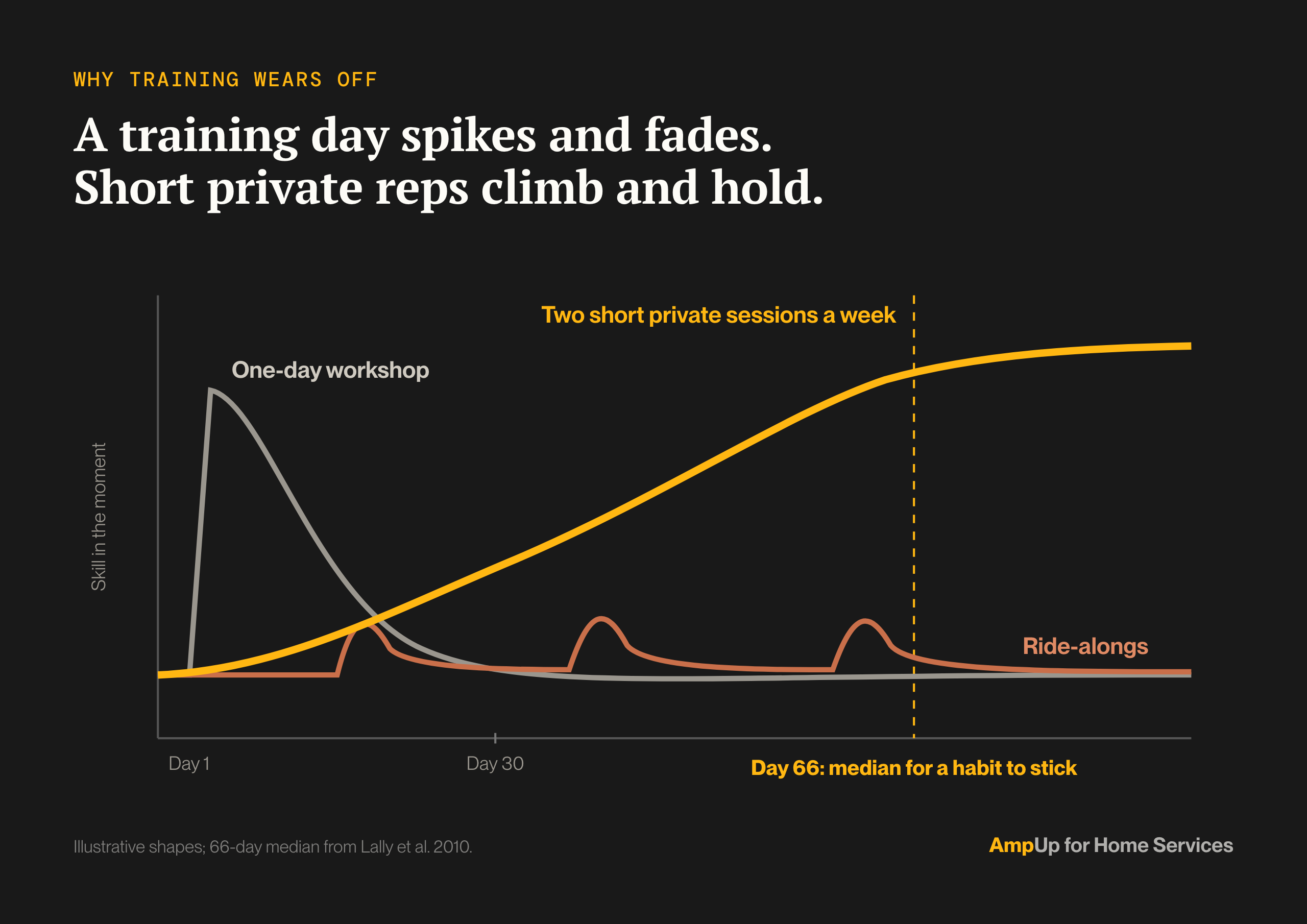
Even a willing veteran drifts back, because selling in a homeowner's kitchen is a habit, and habits do not change on a schedule set by a training calendar. The best-known study of habit formation, run by Phillippa Lally's group at University College London and published in 2010 in the European Journal of Social Psychology, tracked people building one new daily behavior. The median time to make it automatic was 66 days, and the range ran from 18 days to 254. That was for simple behaviors with no customer pushing back.
Now put that behavior under pressure. The homeowner says "I think I'll just repair it one more time." The veteran has handled that sentence the same way for a decade: a small sigh, a lower repair quote, and a job that is a third of the size it should have been. The new response from the training day exists in their head. The old response exists in their hands. Under pressure, the hands win.
A one-day session cannot bridge that. It delivers the new behavior once and then leaves the veteran alone with the old habit for the next 66 days. In-Home Sales Training covers how fast the material itself fades for any rep. With veterans the harder problem is not forgetting. It is that the old habit was never displaced in the first place, because nobody practiced the new one against the exact moment where the old one lives.
What Actually Changes a Veteran Rep
Five things work with veterans. They work because each one respects the record instead of arguing with it.
1. Start from their own appointments, not a curriculum
Do not open with a method. Open with their last twenty appointments, and tell the veteran that is what you are doing and why: you are looking for the one moment worth working on, and they see it before anyone else does. Pull the recordings, or if you have none, ride the next five with a notebook and write down what happened at each decision point: how many options they presented, when financing came up, what they said when the homeowner mentioned repair, whether they asked for the job. Then sit down with the veteran and show them the pattern.
This changes the conversation from opinion to the record. You are no longer a younger manager telling a veteran how to sell. You are two people looking at the same twenty jobs. In the worked example, about twelve of them did not close, and eight of those twelve ended within a minute of the same objection. A veteran will argue with a trainer all day. They rarely argue with their own appointments.
2. Name one gap and leave the rest alone
A veteran will not rebuild their whole approach, and should not. Most of it works. Pick the one moment where the most money leaks, and coach that one moment only. Say it plainly: everything else you do, keep doing. This one sentence, when the homeowner says repair, is where we are going to work for the next month.
This is the opposite of how most sales training is built. A program covers the whole appointment because it has to serve every rep. A veteran needs the opposite: a narrow target they can hit, and respect for the rest. One gap is also small enough to practice until it is automatic, which a whole program never is.
3. Make the practice private
Nothing shuts a veteran down faster than role playing a repair objection in front of the rookies they trained. Status matters, and you lose nothing by protecting it. Give them a way to run the scenario alone: with a manager one on one, or with an AI role play that plays the homeowner and gives feedback with nobody else in the room. AmpUp's role plays are built from that rep's own gaps and the company's own appointments, so the veteran rehearses the exact objection that costs them jobs, without an audience. AI Sales Roleplay for In-Home Objection Handling walks through what one of those sessions looks like.
Private practice also removes the main excuse. A veteran can decline a group session on principle. It is much harder to decline ten minutes alone with a scenario built from a job they lost on Tuesday.
4. Tie the gap to their paycheck, not to the company's close rate
Veterans do not change for the company average. They change for their own number. Do the arithmetic with them. In the worked example that is eight lost jobs in twenty appointments on one objection, times the average replacement ticket, times their commission rate. That is the money sitting on the table in the next month. Put it on paper and let them keep the paper.
This is also why the framing has to be coaching and never monitoring. The moment a veteran decides the recordings exist to catch them out, they stop recording, and the whole thing dies. The pitch is: this is your own coach, built from your own jobs, and the money is yours. For how to put that case to the team, see Will Homeowners Mind If Your Reps Record the Appointment?, which covers the rep side as well as the customer side.
5. Give them a reason to be the example
A veteran has strengths the rest of the team does not. Use them. When their walkthrough is the best on the team, build the walkthrough coaching for newer reps from the veteran's own appointments and tell them so. Now the same system that is asking them to fix one gap is also treating them as the standard everywhere else. Veterans who are treated as the model change faster, because fixing one gap no longer reads as a demotion.
How Do I Turn Techs Into Better Salespeople Without Making Them Pushy?
This question comes up with veterans more than anyone else, because the veteran technician who now sells usually did not choose to. They have fixed systems for twenty years and been handed a price book. Their fear of being pushy is real, and pushing a sales-floor method on them confirms it.
The answer is that the coaching above does not make anyone pushy, because it never adds a close. It fixes the moment where the tech currently goes quiet. A veteran tech who hears repair and drops the subject leaves the homeowner with a failing system and no honest picture of the choice. Coaching them to lay out the repair cost, the replacement cost and the financing, in the plain voice they already use for a diagnosis, is not selling harder. It is finishing the diagnosis. Frame it that way and the pushy objection disappears, because the tech recognizes it as the job they already do.
Training Program vs. Ride-Along vs. Per-Rep Coaching for Veterans
| Approach | What the veteran hears | Starts from | Scope | Who sees the practice |
|---|---|---|---|---|
| Group training program | You have been doing it wrong | A curriculum | The whole appointment | The whole team |
| Manager ride-along | Depends on the manager's record | One appointment, with the manager watching | Whatever happened that day | The manager |
| AI per-rep coaching (AmpUp) | Here is where your own jobs leak | Every one of their appointments | One named gap at a time | The rep, alone |
The ride-along column is the honest middle. It works when the manager has the record to earn the veteran's respect and the hours to ride often enough to see the gap more than once. Most managers have neither, which is the argument in Why Ride-Alongs Don't Scale.
A 30-Day Plan for One Veteran
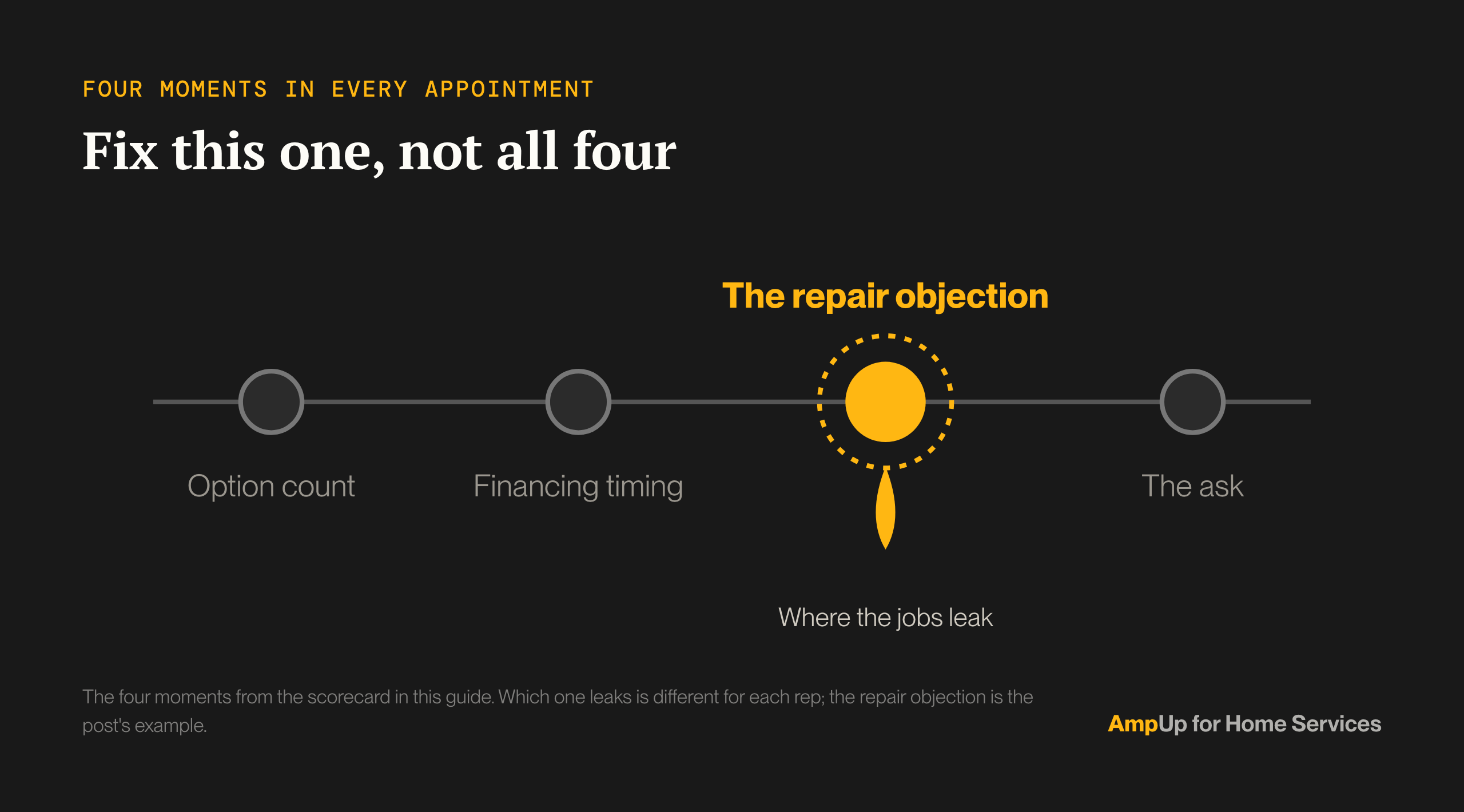
- Days 1 to 5: look at the pattern together. Tell the veteran you are pulling their last twenty appointments to find the one moment worth working on, and that they see it first. Score the same four moments: option count, financing timing, the repair objection, and the ask.
- Day 6: one sit-down. Show the pattern, name the one gap, do the paycheck arithmetic, and agree on the single thing you will both watch. Say out loud what you are not asking them to change.
- Days 7 to 30: private reps. Two short practice sessions a week on that one moment, nobody else in the room. Short sessions spread across weeks beat one long one; the research on spaced practice is summarised in this open-access review. A battlecard before each real appointment that reminds them of the one thing, built for that customer and that job.
- Day 30: same twenty-appointment scorecard, same four moments. Show the veteran the before and after. If the number moved, they will ask what is next. If it did not, you picked the wrong gap, and the same twenty appointments will tell you which one it should have been.
Start with your most experienced rep
Pick the veteran you have given up on coaching and bring us a week of their appointments. We will show you the one moment where their jobs leak, and what their first battlecard would say. They see it before you do.
Book a demo →Frequently Asked Questions
How long does it take a veteran rep to change a selling habit?
Plan for a month of focused practice on one moment, not a day. The Lally habit study found a median of 66 days for a simple new behavior to become automatic, with a range from 18 to 254 days. A veteran who practices one objection response twice a week, with a reminder before each appointment, usually shows a change in that one moment well before the habit is fully automatic. The day-30 scorecard in the plan above tells you whether it moved.
Should I coach veteran reps differently from new hires?
Yes. A new hire needs the whole method, because they have none. A veteran needs one named gap, evidence from their own appointments that it exists, and private practice. Putting a veteran through the new-hire curriculum wastes their time and your credibility.
What if my veteran rep refuses to be recorded?
Start with why. Almost always the fear is that recordings become evidence in a performance conversation. Make the recordings the rep's own coaching material, keep them out of leaderboards and comparisons with other reps, and show the veteran their own number before anyone else sees anything. Reps who understand the recording works for them usually stop objecting.
My top closer is a veteran. Should I leave them alone?
No, but change what coaching means for them. A top closer still has one moment where they leave money on the table, and because they run more appointments, that one gap is worth more than a rookie's whole learning curve. Coach the one gap, and use their strengths as the model for everyone else's coaching.
Does AI coaching work for reps who are not comfortable with technology?
It works when it arrives where they already are and asks nothing new of them. A one-page battlecard on the phone before the appointment and a recap afterward need no setup. Practice scenarios take a few minutes. The veterans who object to technology are usually objecting to being watched, and that is fixed by framing, not by a simpler app.
Related reading
See AmpUp on your own calls
Bring a week of recent in-home appointments. We will show you the one gap costing each rep the most jobs, and what they would practice before the next round of calls.
See a demo