The Forecast Was a Story
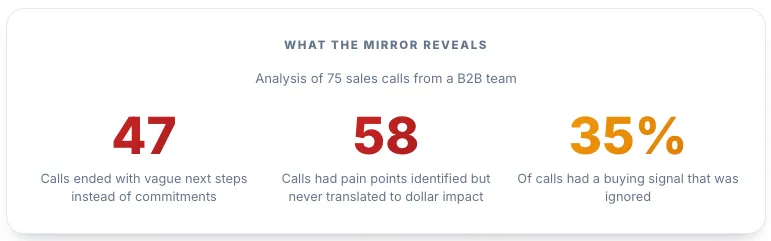
Why Most Sales Forecasts Are Stories, Not Data. Most CROs missed their forecast last quarter. Not because reps sandbagged. Not because deals slipped. Because 58% of 'committed' pipeline was missing clear buying signals from the customer.

Most CROs missed their forecast last quarter.
Not because reps sandbagged. Not because deals slipped. Because 58% of “committed” pipeline was missing clear buying signals from the customer.
That number isn’t a typo. That isn’t a forecasting problem.
It is fiction.
Forecasts fail not because reps lie, but because stories replace customer evidence. Here’s how revenue gets imagined into existence, and how to stop it.

58% of your pipeline is evaporating. You just can’t see it yet.
The Scene That Repeats Every Quarter
It’s week 10. The CRO is on the forecast call, and Ryan is walking through his commit. He’s a solid performer who knows the product cold.
“This one’s solid,” Ryan says. “We had a great demo last week. The VP of Ops loved the ROI analysis. I’m meeting with procurement on Thursday, and then we should be wrapping up legal by the 28th.”
The CRO has heard this before. “What did the VP actually say about timeline?”
“He said they’re motivated to move quickly,” Ryan replies.
“Did he say why?”
“I mean… they’ve been dealing with this problem for a while.”
The CRO knows what this means. Ryan has built a story, a plausible sequence of events that ends in a signed contract. But the story exists in Ryan’s head, not in the customer’s words.
When we analyzed Ryan’s pipeline, 7 of his 12 “committed” opportunities were missing clear customer evidence for at least one of the three critical buying signals.
Across the team, the pattern held:
58% of committed pipeline had the same gap.
That is a $2.3M fiction masquerading as a pipeline.
The Inside View and the Outside View
Daniel Kahneman won a Nobel Prize for explaining why this happens. He showed that humans reason about the future in two fundamentally different ways, and we consistently choose the wrong one.
The Inside View: You construct a narrative by imagining the specific sequence of events that will lead to your outcome. You picture the procurement meeting, the handshake, the signature. The story feels real because you can see it.
The Outside View: You ask what actually happens to deals like this one. When you look at the data. Stage 3 opportunities with 30 days left and no procurement engagement, the failure rate is over 80%.
Ryan isn’t lying. His brain is doing what all human brains do: constructing a plausible story and mistaking it for a prediction.
The outside view tells you the truth. But to use it, you need to hear evidence directly from the customer. Not interpretation. Not what the rep thinks they heard. Only what the customer actually said matters.
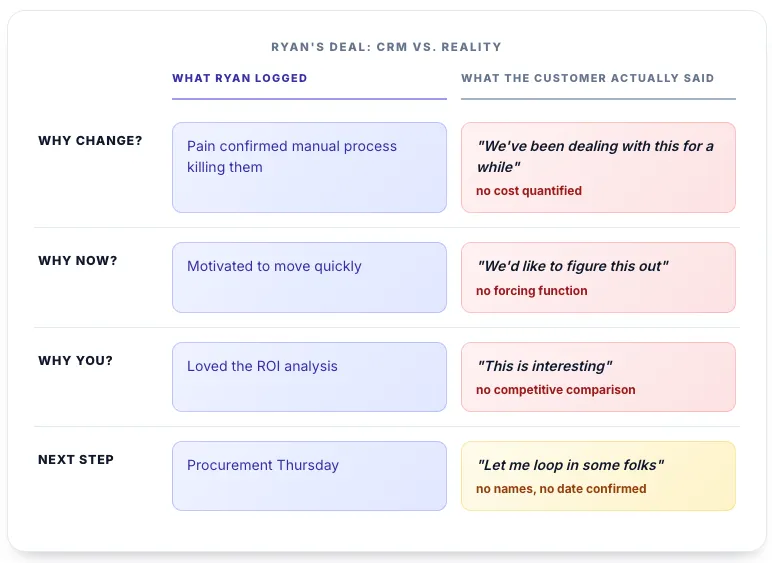
The CRM showed a commit. The transcript showed a conversation.
Reps project problems onto customers based on title. They pattern-match vague statements into familiar scripts. Optimism feels productive. Evidence feels dangerous.
The Only Evidence That Matters
You can’t believe a deal into existence. Only the customer can say it’s real.
For a deal to exist, and to achieve strong forecast accuracy, the customer has to express three things in their own words:
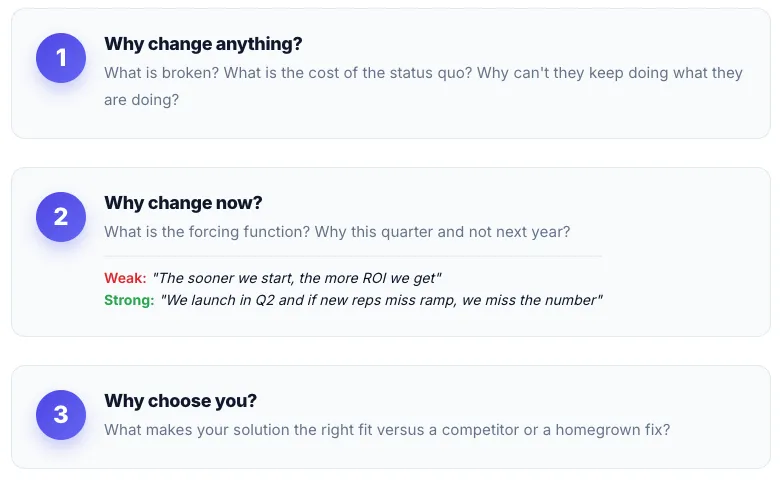
If any of these is missing, there is no deal.
The deal is already lost, you just haven’t admitted it yet.
Why This Is Brutal
The “three whys” leave you nowhere to hide. That pipeline you’ve been nursing? Half of it evaporates when you apply this standard honestly.
Reps resist this out of fear:
Fear of hearing no.
Fear of discovering sunk costs.
Fear of asking a question that exposes a hole in their case.
But fear traps you in the “friend zone”, guaranteeing you waste resources on a prospect who likes you but will never buy.
The best sellers ask the uncomfortable questions early. They would rather hear “we’re not ready” in week two than suffer a slow “no” in week twelve.
The Real Problem Isn’t Skill, It’s Emotional Cost
Sales leaders see the problem and reach for the familiar solution: more training. Better frameworks. Tighter qualification criteria. MEDPIC. MEDDIC. BANT. The three whys.
But reps already know these frameworks. The issue isn’t awareness, it’s emotional labor.
When a rep asks “Why now?” and the prospect says “We’d like to figure this out,” the rep faces a choice:
Option A - Document the Truth. Watch the deal slip. Explain why a commit is now at risk.
Option B - Fill the gap with assumptions. Keep the CRM Green. Avoid discomfort.
Most reps choose Option B. Not because they’re dishonest, but because documenting uncertainty feels like failure when quota is breathing down their neck.
This is why training doesn’t fix it. You’re not fighting a knowledge problem.
You’re fighting human psychology under pressure.
The Gains Trap
Even when reps do ask “Why now?”, they accept weak answers because they sound plausible.
Customer says: “This is good for us, and the longer we wait, the less we get to capitalize on the gains.”
Rep hears: “Why now” ✓
But this is weak sauce. But gains don’t drive actions. Loss does. Humans are wired to avoid pain, not chase upside. Kahneman proved this, we’re 2-3x more motivated by loss aversion than gain seeking.
A real “Why now” sounds like this:
“We’re launching a major product next year. We’ll need to hire 20 new reps. If we don’t have a system to get them ramped faster, those reps will miss quota, we’ll miss the launch number, and I’ll be the one explaining to the board why we left $10M on the table.”
That’s not about gains. That’s about concrete, imminent, career-threatening loss.
If your customer can’t articulate a loss scenario, you don’t have “Why now.”
You have “Why maybe someday.”
The Mirror That Sets You Free
The hardest part isn’t knowing at to look for. It’s holding the mirror steady when your quota is screaming at you to believe.
This is where traditional training breaks down.
The only way to solve this is to remove the emotional friction.
AI does two things traditional training can’t.
First, it creates the first draft for you. You don’t have to agonize over admitting what’s missing. The system flags it neutrally: No cost quantified in transcript.
There’s no judgment. No confrontation. Just evidence.
Second, it challenges assumptions before they harden into commitments.
If a rep writes “Customer confirmed $500K pain” but the transcript only shows “This is costing us,” the system calls it out.
The story doesn’t make it into the forecast.
When every call is transcribed and analyzed, you can’t remember the conversation differently than it happened. Forecast calls stop being debates of opinion and start becoming discussions of evidence.
Practice That Transfers
But awareness alone doesn’t change behavior. You need repetition in context.
Traditional role-play is often a scheduled event disconnected from live deals. What changes behavior is practice that is bite-sized, highly personalized, and built in the context of a specific deal and deal execution patterns.
With AmpUp, the system knows Ryan’s patterns. For example, he backs off when it is time to press for commitment. Before his next call, Ryan practices that exact conversation. He sees how a top performer handled the same objection and tries the direct question out loud until it feels natural.
That’s how stories turn into evidence.
Book a Demo with AmpUp
Ready to see how AmpUp can transform your sales team? Schedule a demo with AmpUp and discover how AI-powered sales coaching delivers measurable results.
Frequently Asked Questions
Q: How do we stop reps from turning their deals into narratives instead of evidence-based forecasts?
The problem isn’t dishonesty, it’s cognitive load and emotional friction. When a rep documents that a deal is missing buying signals, it feels like admitting failure. AmpUp removes that friction by making the gap visible neutrally. The system flags missing evidence from the transcript, not based on the rep’s judgment. This shifts forecasting from opinion debates to evidence discussions, and deals stay in the pipeline only when the customer has actually expressed the three critical buying signals.
Q: What are the three critical buying signals we should be looking for?
First, the customer must articulate a specific problem with quantified impact. Second, they must acknowledge this is urgent, but not because of gains, because of loss they’re avoiding. Third, they must confirm they have budget and authority to solve it. Until all three are present in the customer’s own words, the deal is fiction. AmpUp analyzes transcripts to verify these signals are actually there, not assumed.
Q: Why does traditional training on frameworks like MEDDPICC fail to fix forecast accuracy?
Because frameworks teach what to ask, but reps already know what to ask. The real barrier is emotional labor under pressure. When a rep hears a weak answer to “Why now?” and feels quota breathing down their neck, they choose comfort over truth. AmpUp fixes this by removing the emotional cost, the system surfaces the gap, not the rep. No confrontation, no shame, just evidence.
Q: How does this improve deal execution beyond just forecasting accuracy?
When every call is transcribed and analyzed for buying signals, reps start preparing differently. They know they’ll need to get explicit answers, so they practice harder. They enter calls with more focus because they’re not winging it. The result is better discovery, more confident conversations, and deals that actually progress instead of stalling for three weeks before dying in legal.

Book a demo with us
See how AmpUp turns every call into a coaching opportunity.
Written by

Amit Prakash
Founder & CEO, AmpUp
Amit is the founder and CEO of AmpUp. Previously, he built ThoughtSpot from zero to over $1B in valuation, leading sales and customer success. He's passionate about using AI to eliminate execution variance in sales teams and make every rep perform like the top 10%.
Stay up to date with AmpUp
Follow AmpUp on LinkedInFollow us on LinkedIn for the latest on AI-powered revenue intelligence.