Ask a room of advisors which AI tool they use and most will name a notetaker. That is a good start and an incomplete answer. AI now shows up in the CRM, the planning software, the archive and the marketing calendar, and the job that moves a firm's organic growth rate is often the least served. This guide groups the tools by the job they do, describes each one in its own words, and lists the published price where there is one. We checked each vendor's own page, or the named trade publication where there is none, on November 5, 2026.
The usual first AI tool is a notetaker such as Jump or Zocks, used in 42.86% of advisory practices (T3/Inside Information, 2026). Other jobs sit beyond it: CRM agents, planning and tax, compliance capture, and growth from existing relationships. Pick one tool per job, and make sure each one writes back to the CRM.
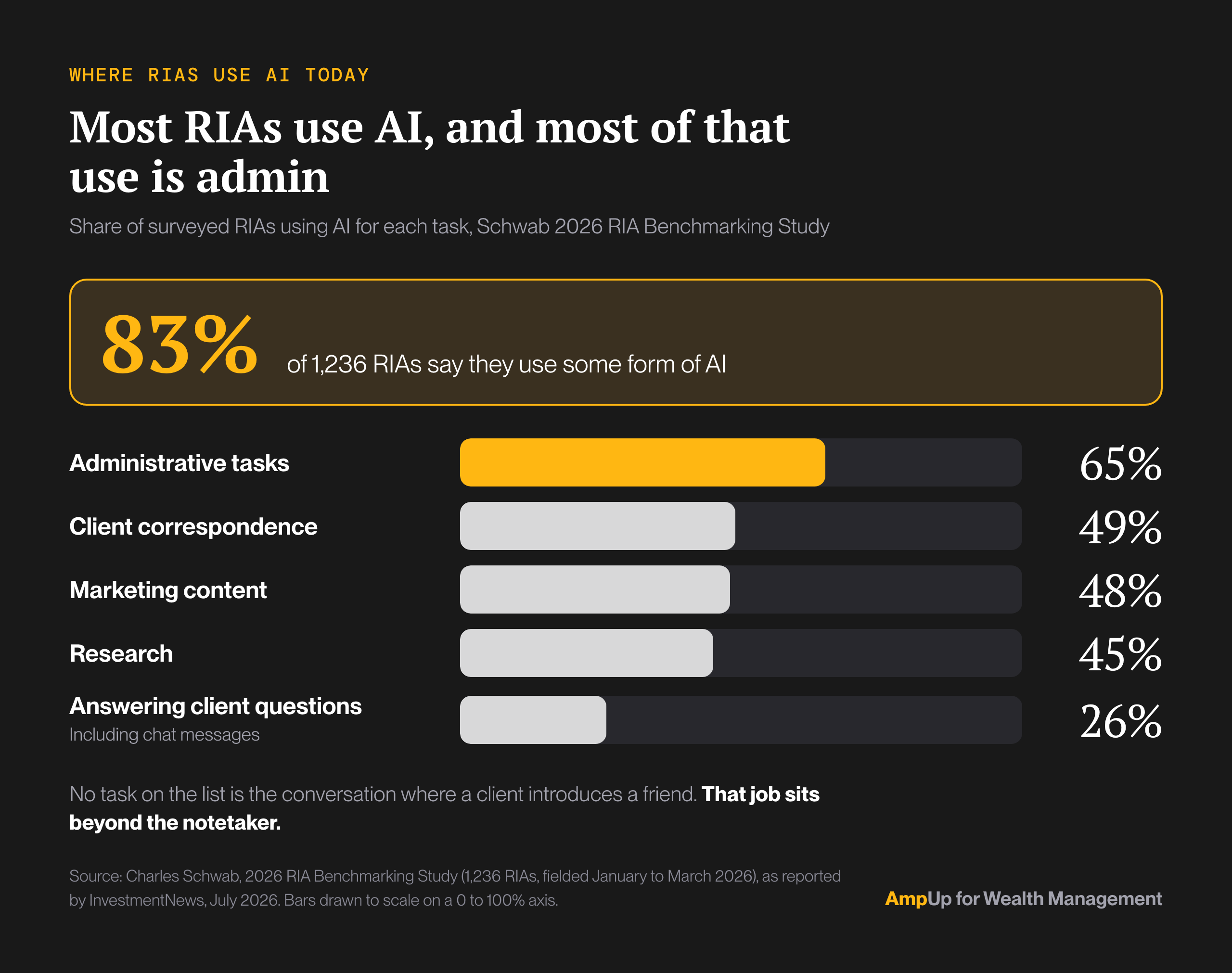
- 83% of RIAs in Schwab's 2026 RIA Benchmarking Study use some form of AI, most often for administrative tasks (65%). Only 26% use it to answer client questions.
- AI notetakers are now their own category: they are used in 42.86% of advisory practices, and Jump (22.68% market share) and Zocks (10.22%) rank first and second, per the T3/Inside Information 2026 Software Survey.
- Beyond notes, the jobs are CRM agents, planning and tax, estate, finding new households, staying visible, compliance capture, and growth from existing relationships.
- A notetaker gives the advisor time back. A growth tool moves the organic growth rate. Different jobs with different measures, and good firms run both.
- Governance lags adoption: only 28% of financial services firms test or validate AI outputs (ACA Group, 2025). Ask every vendor the same eight questions before you sign.
The short version: the best AI tools for financial advisors, by job
One tool per job, not one tool for everything. The table lists each tool's job, the CRMs its own pages name, and its published price. Every entry was checked on the vendor's own pricing or product page on November 5, 2026, except the four noted below the table, which rely on a named trade publication. "Not published" means the vendor quotes on request. Prices change, so confirm before you buy.
| Tool | Job | CRM connection (per the vendor) | Published price |
|---|---|---|---|
| Jump | Meeting notes, onboarding, growth add-on | Redtail, Wealthbox, Salesforce FSC | Meet $100 per advisor/mo; Onboard and Grow add-ons $50 each |
| Zocks | Meeting notes, client data, forms | Redtail, Wealthbox, Salesforce | $67 / $117 / $184 per user/mo, billed annually |
| Zeplyn | Meetings, prep, opportunity mining, advisor coaching | Salesforce, Wealthbox, Redtail (logos on its site) | Not published |
| Finmate AI | Meeting co-pilot | Not stated on its homepage | Not published |
| Wealthbox | CRM with AI Agents and an AI Notetaker | Is the CRM | $59 / $75 / $99 per user/mo; AI Notetaker $49 per user/mo |
| Salesforce Agentforce for Financial Services (formerly Financial Services Cloud, or FSC) | CRM with AI agents (Agentic Advisor) | Is the CRM | Not published for Agentic Advisor |
| Orion Denali AI | AI across Orion's suite | Embedded in Redtail CRM (InvestmentNews) | Not published |
| Holistiplan | Tax planning from returns, insurance review | Not checked | Basic Tax from $749/yr (30 households); Premium Tax from $1,499/yr |
| FP Alpha | Tax, estate and insurance planning | Not checked | All-In-One $1,995/yr |
| RightCapital | Financial planning, Iris AI planning agent | Redtail, Wealthbox | $149.95 / $209.95 / $254.95 per advisor/mo; Iris from Premium |
| Vanilla | Estate document analysis and summaries | Not checked | Not published (user-based tiers) |
| Conquest | AI planning engine | Partners include Jump and Zocks (InvestmentNews) | Subscription; not published |
| Claude for Financial Advisors | General assistant with advisor connectors | Wealthbox and Salesforce connectors | Enterprise plans; reported $70 to $120 per user/mo, usage-based |
| ChatGPT, Microsoft Copilot | General assistants | Varies by plan and setup | Not checked |
| Smarsh | Archive and capture, including Claude Enterprise records | Not applicable | Not published |
| Global Relay | Archive and AI surveillance | Not applicable | Not published |
| FINNY | Finding new households | Not checked | $50/mo plus a share of assets from new clients (20 bps average for LPL advisors) |
| Catchlight | Scores which prospective clients are likely to become clients | Not checked | Not published |
| Snappy Kraken | Marketing automation | Not checked | Campaigns $199 / $299 / $899 per mo on an annual term, plus setup |
| AmpUp for Wealth Management | Growth from existing relationships | Wealthbox, Redtail, Practifi, Salesforce FSC | Quoted per firm |
The four entries checked against a trade publication, because the vendor had no public page for the product, are Orion's Denali AI (InvestmentNews, July 2026), Conquest (InvestmentNews, September 2026), Claude for Financial Advisors (WealthManagement.com, September 2026) and FINNY's pricing (WealthManagement.com, August 2026). "Not checked" means we did not verify that vendor's CRM list, not that it has none.
How are wealth management firms using AI beyond note taking?
Mostly for admin, so far. In Schwab's 2026 RIA Benchmarking Study (1,236 RIAs, fielded January to March 2026, reported July 2026), 83% of firms said they use some form of AI. The most common use was administrative tasks at 65%, followed by client correspondence (49%), marketing content (48%) and research (45%). Only 26% used AI to answer client questions or chat messages.
The notetaker is the clearest example. The T3/Inside Information 2026 Software Survey (2,906 respondents) gave AI notetakers their own category for the first time. Financial Planning's report of it says AI notetakers are used in 42.86% of advisory practices. Jump ranked first with a 22.68% market share and Zocks second with 10.22%, up from 8.36% and 1.74% the year before, when both were measured in a different category. The report does not define the market-share denominator, and the survey's authors think real adoption is higher.
So the question has moved from "should we use AI?" to "what comes after the notes?". BlackRock's May 2026 article 3 ways AI accelerates advisor growth and scale gives a useful map. It names three paths: workflow automation for efficiency, AI-enabled estate planning for high-net-worth clients, and data-driven marketing to reach new clients. The estate path matters because the work is heavy: in BlackRock's 2026 Advisor Trends Survey (1,023 advisors), 62% said estate planning is one of the most time-intensive services they provide.
None of those three paths is about the conversation where a client introduces a friend. That gap is the subject of the growth section below.
Best AI tools for advisors that do more than take notes
Meeting assistants that now go further
The leading meeting tools have grown well past transcription. Jump calls itself "the end-to-end AI platform built for advisors". Its Meet plan covers prep, notes and follow-up, and its Grow add-on, in Jump's words, surfaces "held-away assets, referrals & opportunities". Jump says it is fully embedded inside Redtail and syncs with Wealthbox and Salesforce FSC.
Zocks bills itself on its pricing page as "the #1 rated AI assistant for financial services" and says it never records client conversations. It schedules and preps meetings, takes notes, completes intake forms, and offers Client Queries to find clients with held-away assets or upcoming life events.
Zeplyn calls itself "The Agentic AI Operating System for Wealth Management", with recording-free notes, meeting prep, opportunity mining and an advisor coaching feature that evaluates advisor conversations. Finmate AI describes itself as "Your Agentic Co-Pilot for Financial Advisory" and publishes little more on its homepage. For a head-to-head on the two leaders, see Jump vs Zocks vs AmpUp, Jump AI alternatives and Zocks alternatives.
CRMs with AI agents
The CRM vendors are adding AI of their own. Wealthbox lists AI Agents as available on all its plans, and offers an AI Notetaker add-on at $49 per user per month on top of its $59, $75 and $99 plans.
Salesforce FSC gained Agentic Advisor in June 2026, InvestmentNews reported. Its first piece, Meeting Concierge, prepares a brief, gives a discussion guide in the meeting, and drafts follow-ups that become Salesforce records only after the advisor saves them. Salesforce's training material says it keeps AI-generated summaries rather than full audio or transcripts.
Orion, which owns Redtail, offers Denali AI in three tiers. InvestmentNews reported in July 2026 that the "Powered by Denali" tier is embedded across Orion's products, Redtail CRM included.
Planning, tax and estate
Planning is where AI takes on some of the most specialist work. Holistiplan scans tax returns, models scenarios and reviews insurance declarations, with Basic Tax from $749 a year for 30 households. FP Alpha describes "advisor-trained AI to unify tax, estate, and insurance planning" at $1,995 a year for its All-In-One plan.
RightCapital includes its Iris AI planning agent from the Premium tier ($209.95 per advisor per month). Vanilla calls itself "the first AI-powered estate advisory platform"; its V/AI features extract key terms from estate documents and generate visual summaries. Conquest (formerly Conquest Planning) began opening its planning engine to independent firms of 10 advisors or fewer in September 2026, starting with a test group, per InvestmentNews.
General assistants
General assistants are now built for advisors too. Anthropic launched Claude for Financial Advisors on September 14, 2026, a set of connectors and workflow skills for research, meeting prep and documentation. WealthManagement.com reported connectors to Schwab, Orion, Wealthbox, Zocks and others, availability on Enterprise plans with audit logs, and a ballpark of $70 to $120 per user per month from Anthropic, which called pricing usage-based.
ChatGPT and Microsoft Copilot are the other general assistants advisors name; BlackRock lists both. The rule for all three is the same: use them under the firm's own business plan and policies, never a personal account with client data. How AmpUp handles compliance sets out why the container matters more than the model.
Compliance capture and archiving
Every AI output that touches a client can become a record. Smarsh captures Claude Enterprise records into its Professional Archive, where firms apply retention, supervision and legal hold, and says it governs only the records its integration captures. Global Relay brought an enhanced AI surveillance product to the May 2026 FINRA Annual Conference; it says the product reads whole conversations rather than isolated sentences. Some meeting tools write into these archives directly: Mili, for example, says it sends notes, follow-ups and transcripts into a firm's own Global Relay archive.
Best AI tools for financial advisors to grow their book
Growth technology for wealth management firms covers three different jobs, and each has its own tools. Many roundups stop at the notetaker, so it helps to separate them.
- Finding new households. FINNY describes itself as an AI growth and marketing platform for advisors. In August 2026 it moved to pay-as-you-grow pricing: $50 a month plus an annual share of assets from the clients it helps bring in, 20 basis points on average for LPL advisors, per WealthManagement.com. Catchlight calls itself an "Organic Growth Platform" and scores which prospective clients are most likely to become clients.
- Staying visible to clients and centers of influence. Snappy Kraken offers marketing automation for advisors, with Campaigns plans at $199, $299 and $899 a month on an annual term.
- Growth from existing relationships. The introduction a client or a CPA makes. It is the channel most firms depend on, and often the least instrumented. This is where AmpUp for Wealth Management sits: it spots the referral moment, drafts the ask in the advisor's own voice, and traces it to the introduction and the assets.
Referrals are where the evidence is strongest. Cerulli research reported by InvestmentNews found 93% of billion-dollar RIAs rank referrals as a top organic growth strategy. Yet the ask rarely happens. In an older but widely cited 2010 study by Advisor Impact with Schwab and Texas Tech, 91% of clients said they were comfortable referring their advisor, and only 29% had done so in the past year. The clients are willing. The gap is the ask.
Several meeting tools now surface growth signals: Jump's Grow add-on and Zocks' Client Queries both point advisors at referrals, held-away assets or life events. That helps an advisor see the moment. The rest of the job is what happens next: deciding which household to ask this week, finding words this advisor will actually say, and tracing the ask to an introduction and the assets it brought. A growth layer is built for that part. Best software for RIA client referrals compares the referral tools in depth, and tools that find referral opportunities in client conversations covers how conversation signals work.
Do you need both an AI notetaker and a growth tool?
Usually, yes, because they do different jobs and answer to different numbers. The notetaker gives the advisor time back, and is judged on hours saved and record quality. The growth tool turns relationships into new assets, and is judged on the organic growth rate. One does not replace the other. In practice, the growth tool reads what the notetaker and the CRM already hold.
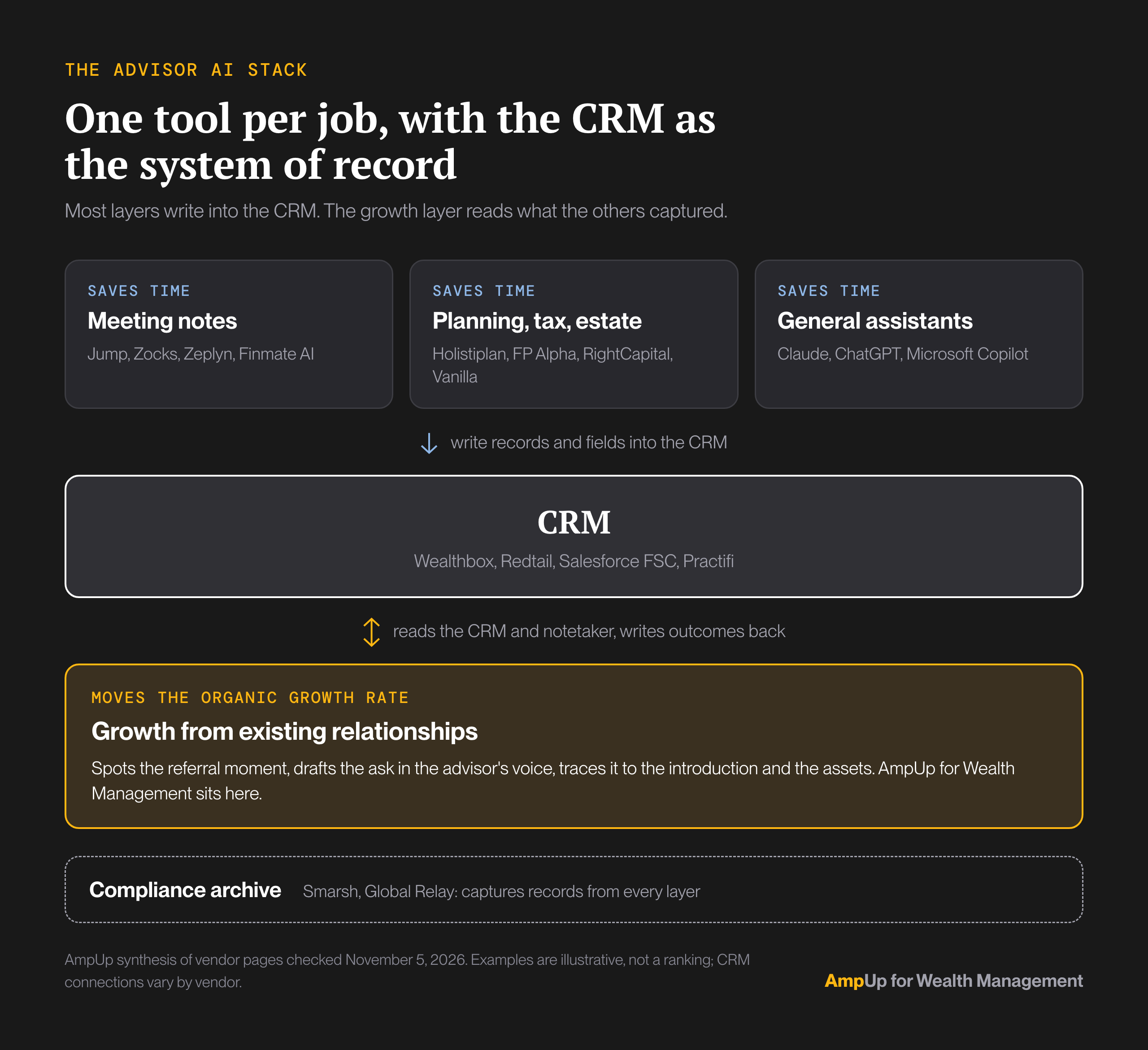
That makes the notetaker's output more valuable than its action items. When you evaluate one, check that it captures what a growth tool needs to read. Beyond action items, a notetaker should extract:
- Life events: a retirement date, a sale of a business, a new grandchild, a move.
- Family members: adult children, parents, a spouse who has not joined a meeting yet.
- Other advisors: the CPA, the estate attorney, an outside manager the client mentions.
- Held-away assets: an old 401(k), stock compensation, an account a spouse manages.
- People the client named: a friend going through a transition, a colleague asking for advice.
- Compliments and concerns: what the client values, and what worries them.
If those fields land in the CRM, any growth tool can use them. If they stay in a summary paragraph, they are hard for anyone to act on. Tools for next-gen clients and held-away assets covers the family and outside-asset fields in more depth.
What should a growth leader at a multi-advisor RIA look for?
A growth leader at a multi-advisor RIA should look for a growth layer: AI that reads the firm's client conversations and CRM, helps each advisor make the ask, and reports the organic growth rate by source in one firm-level view, which is the job of AmpUp's Growth Office. A growth leader buys for the firm, not for one advisor. Five tests matter most:
- A firm view across advisors. The growth leader needs the organic growth rate by source and the activity behind it, in one place. Look for views framed around households and teams that need support.
- Compliance first. Records retained and accessible under the Advisers Act books and records rule (Rule 204-2), and, as good practice, every output traceable to its source. For referral tools, the SEC Marketing Rule (Rule 206(4)-1) treats a client referral as a testimonial, and compensation is what turns it into a regulated arrangement. When a referral becomes an endorsement explains the line.
- CRM write-back. Every tool should read from the CRM and write outcomes back into it. A tool that becomes a second system of record creates work and exam risk.
- Advisor trust. No leaderboards and no rankings of named advisors. Once advisors read a tool as monitoring, they stop feeding it.
- Pricing per advisor versus per firm. Per-seat tools scale with headcount: at $100 per advisor per month, a 20-advisor firm pays $24,000 a year before add-ons. Firm-level tools are quoted on scope instead.
The ROI of AI for wealth management firms covers how to model the return on each layer of the stack.
What questions should you ask any AI vendor?
Most firms adopt AI faster than they govern it. In the ACA Group and NSCP 2025 AI Benchmarking Survey of compliance professionals, 71% of financial services firms formally use AI, but only 48% have an AI governance committee, 43% perform enhanced due diligence on AI vendors, and 28% test or validate AI outputs. Eight questions narrow most of that gap:
- Is client data ever used to train your models or your providers' models?
- Do you store audio, transcripts or only summaries, and for how long?
- Which archive do your records flow into (Smarsh, Global Relay, our own), and how?
- Can you share a current SOC 2 Type II report and your sub-processor list?
- Which CRM fields do you write, and does the advisor review before anything is saved?
- Can every output be traced to the conversation or document that produced it?
- Who reviews AI output before a client sees it, and can compliance set language rules centrally?
- What happens to our data if we leave?
Ask the same questions of every vendor in the table, including us. The answers are more useful side by side than any feature list. How AmpUp answers these questions is on our compliance page.
Where does AmpUp for Wealth Management fit?
AmpUp for Wealth Management is the growth layer that sits on top of the notetaker and the CRM. It does not replace either. It does one job: raise the firm's organic growth rate, starting with referrals.
- Spot the moment. It reads across client conversations and scores the book, so each advisor sees a short weekly list of who is worth asking, with the reason, and when to wait instead.
- Give them the words. The ask arrives drafted in that advisor's own voice, and the advisor can rehearse it against a simulated version of that client first. The advisor decides every ask.
- Show it landed. Every ask traces to the introduction and the assets it produced, and the growth leader sees the whole picture in the Growth Office.
It reads from the systems a firm already runs, including Wealthbox, Redtail, Practifi and Salesforce FSC, and writes outcomes back. Where a firm already records with Jump, Zocks, Zoom or Teams, AmpUp reads that output instead of adding capture. Client data is never used to train models, and the platform is SOC 2 Type II audited. Pricing is quoted per firm: advisor seats with every play included, plus the Growth Office at firm level.
Frequently asked questions
What is the best AI notetaker for financial advisors? By adoption, Jump and Zocks lead. In the T3/Inside Information 2026 Software Survey, Jump ranked first in the AI notetaker category with a 22.68% market share and Zocks second with 10.22%. Jump's Meet plan is $100 per advisor per month; Zocks runs $67 to $184 per user per month billed annually. Wealthbox and Salesforce FSC now offer meeting AI inside the CRM too. Jump vs Zocks vs AmpUp compares the two leaders.
Which AI tools integrate with Redtail, Wealthbox or Salesforce Financial Services Cloud? Per their own pages, Jump connects to all three, Zocks to Redtail, Wealthbox and Salesforce, and RightCapital to Redtail and Wealthbox. Orion's Denali AI is embedded in Redtail CRM. AmpUp for Wealth Management reads from and writes back to Wealthbox, Redtail, Practifi and Salesforce FSC.
Are AI tools compliant with SEC and FINRA recordkeeping rules? A tool is not compliant by category; the firm's use of it is. AI notes that become part of the record must be retained and accessible under Rule 204-2, and communications fall under supervision. As good practice, firms should also be able to trace each output to its source. Confirm where records are stored, which archive they reach, and whether client data trains models.
How much do AI tools for financial advisors cost? At published rates checked November 5, 2026: meeting assistants run $67 to $184 per user per month (Zocks) or $100 per advisor per month (Jump Meet); Wealthbox's AI Notetaker is $49 per user per month; RightCapital runs $149.95 to $254.95 per advisor per month; Holistiplan starts at $749 a year. Many vendors quote on request.
Can AI help an advisor get more referrals? It can help with the parts that usually break: noticing the moment, finding words the advisor will actually say, and following through. 91% of clients said they were comfortable referring their advisor in a 2010 study, yet only 29% had done so in the past year. AI cannot create the relationship; it can make sure the ask happens.
Should a firm use ChatGPT or Claude directly with client data? Only under the firm's own business or enterprise plan, policies and archive, never a personal account. Claude for Financial Advisors runs on Enterprise plans with audit logs, and Smarsh can capture Claude Enterprise records. Check retention, training terms and supervision with compliance first.