Every aerospace and defense shop has a short list of people it cannot afford to lose. The technician who can hear a bearing fault in a test cell before the data shows it. The inspector who knows which drawing note gets misread by every new hire. The assembler who has done the wire harness routing on one airframe for twenty years and has never written any of it down. When they retire, the work instruction stays and the knowledge goes, and the first anyone notices is a nonconformance six months later.
The short version. The best way to document expert knowledge on the shop floor is a structured interview around one procedure, recorded, turned into a course with an assessment, and signed off by the same expert. It keeps the judgment that written SOPs drop, scales where shadowing cannot, and can be revised when the procedure changes.
What tribal knowledge is, and why the work instruction does not hold it
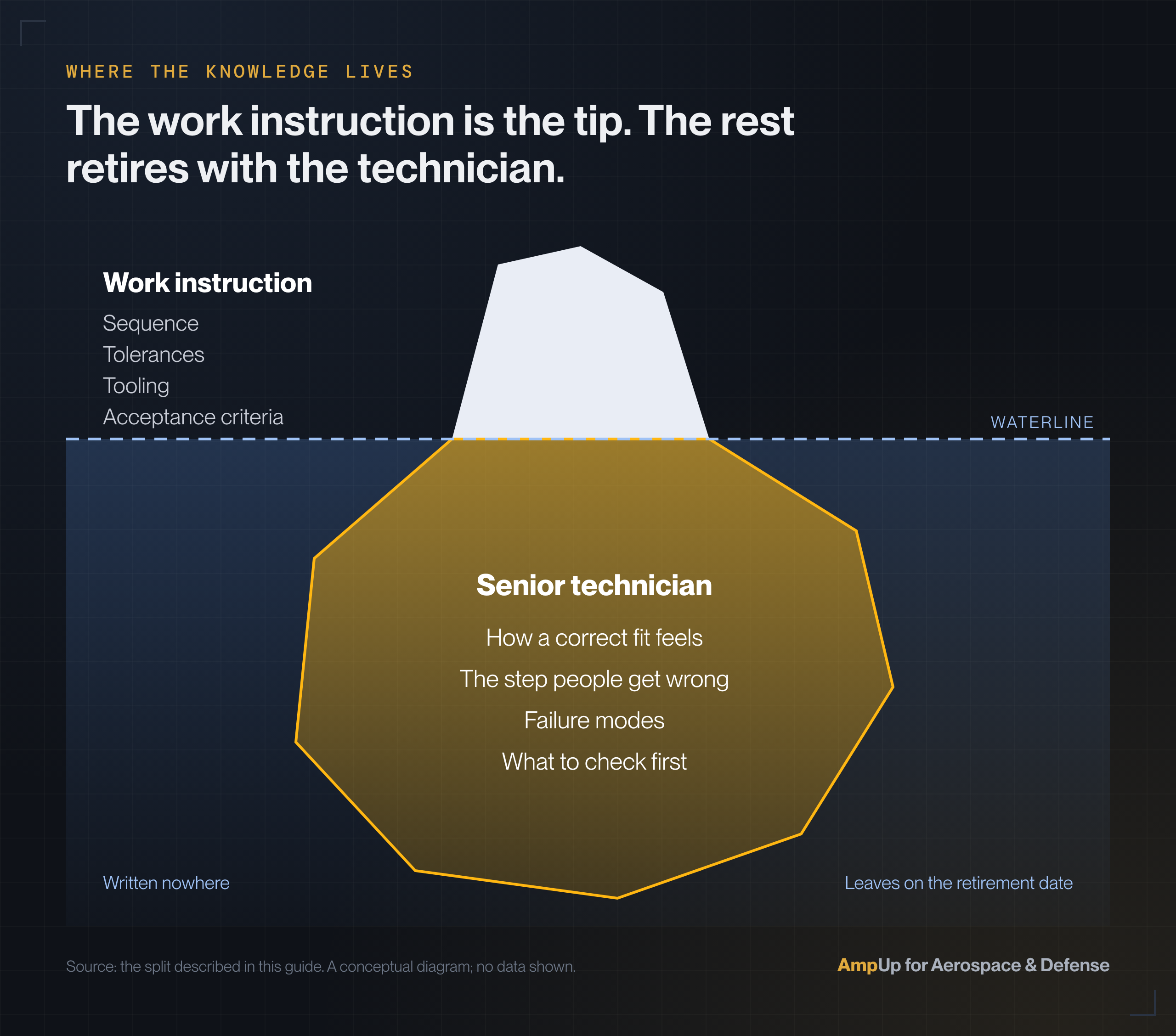
Tribal knowledge is the know-how a shop runs on that is not written anywhere: what a correct fit feels like, which step in the procedure is the one people actually get wrong, what to check first when a part passes inspection and still fails on the aircraft. It is the difference between following the work instruction and getting the job right when the work instruction runs out.
Work instructions are not the place for it, and that is by design. A controlled document states the sequence, the tolerances, the tooling and the acceptance criteria. It is revision-controlled, approved and audited, and it would stop being any of those things if it carried every judgment call a senior technician makes. So the sequence lives in the document and the judgment lives in the person. For twenty years that split works. Then the person announces a retirement date.
The failure that follows is rarely dramatic. New technicians do what the document says. Yield drifts. Rework climbs on one part number. Somebody starts calling the retired technician at home. None of that shows up in a training record, which is a point the knowing-doing gap article makes at length: a completion record says the manual was read, not that the work will be done correctly next month.
Why the window is closing in aerospace and defense
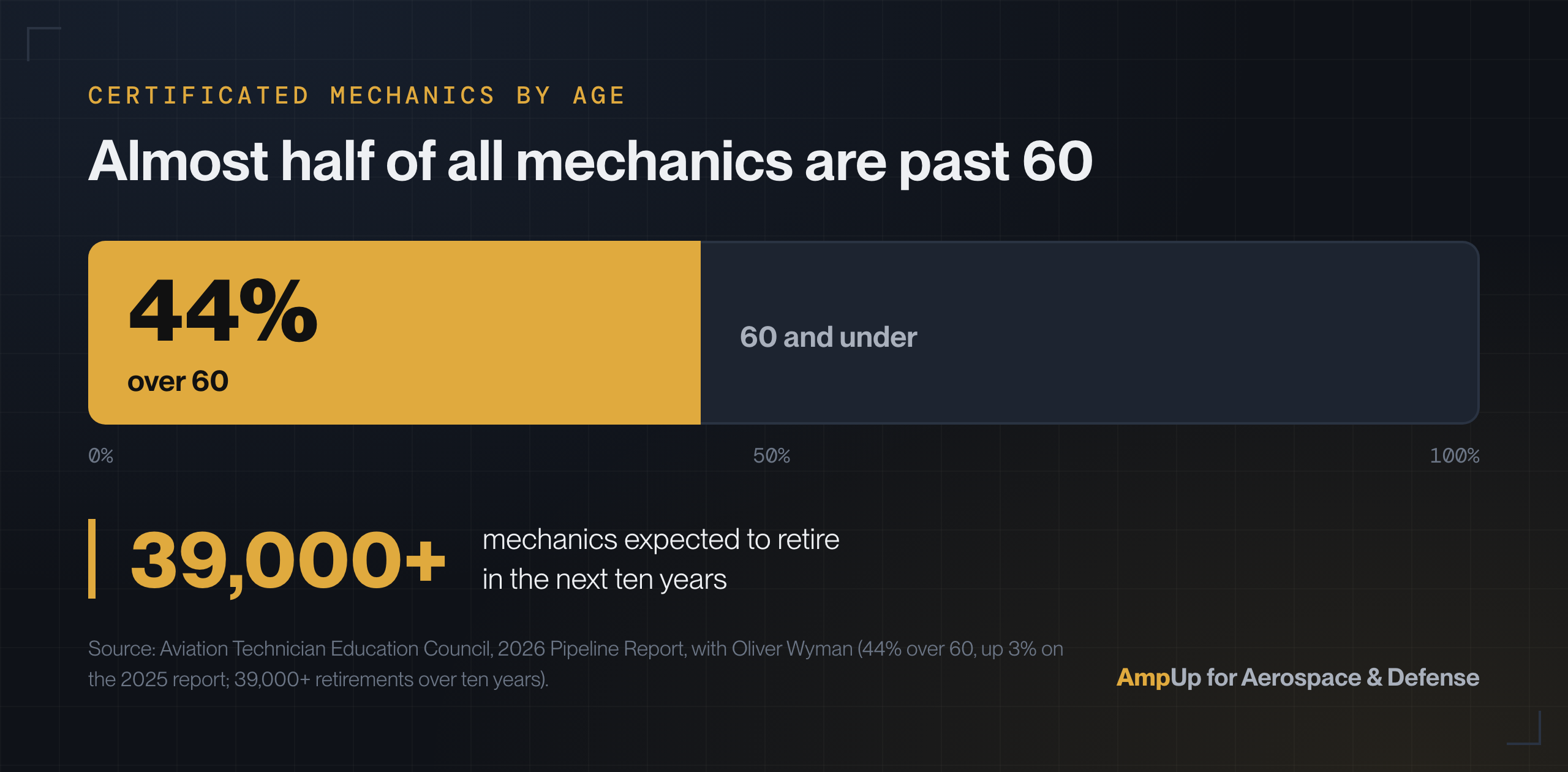
The numbers say this is a current problem rather than a coming one. The Aviation Technician Education Council’s 2026 Pipeline Report, produced with Oliver Wyman, puts 44 percent of certificated mechanics over the age of 60, a 3 percent increase on the 2025 report, and expects a retirement wave of more than 39,000 mechanics over the next ten years. Across US manufacturing, Deloitte and The Manufacturing Institute project a need for as many as 3.8 million new employees between 2024 and 2033, with around 1.9 million of those roles at risk of going unfilled.
The A&D sector is not short of new people so much as short of time to make them proficient. AIA and McKinsey’s 2025 talent study counts a US A&D workforce of 2.23 million, up 2.9 percent on the year, with attrition holding at nearly 15 percent, more than double the average across other US industries. Every one of those departures takes some judgment with it, and every arrival needs it back faster than a hand-built training pipeline can deliver.
One figure cuts the other way and is worth knowing. The Bureau of Labor Statistics’ 2025 median age by industry puts aircraft, engine and parts manufacturing at 42.3 years, slightly younger than manufacturing overall at 43.9. The retirement risk is not an old workforce on average. It is a specific concentration: a small number of people, often one per critical process, who hold what nobody else does. That makes the problem more tractable than the headline numbers suggest, because the list of people and procedures is short enough to write down.
Best way to document expert knowledge on the shop floor
Four methods are in common use. They are not interchangeable, and most shops default to the two that work least well at scale.
| Method | What it captures | What it loses | Reaches | Updatable | Assessable |
|---|---|---|---|---|---|
| Shadowing | Everything, including feel and judgment, for the one person watching | Everything, when the shadow moves on. Nothing is recorded. | One learner per expert per period | No | Only by observation |
| Written SOP or work instruction | Sequence, tolerances, tooling, acceptance criteria | Judgement, failure modes, the step everyone gets wrong, why | Everyone, as a document | Yes, under document control | Read-and-sign at best |
| Video of the expert | The visible work and whatever the expert says while doing it | The reasoning they do not say aloud. Hard to search, hard to revise one step of. | Everyone, passively | Re-shoot | No |
| Structured expert interview turned into a course | Sequence from the document plus judgment, failure modes and corrections from the expert | Physical feel, which still needs supervised practice | Everyone, through the LMS | Yes, section by section | Yes, with scenarios and an assessment |
Shadowing is the method most shops actually use, and it is the one that fails at the retirement date, because it transfers knowledge to one person and records nothing. If that person leaves too, the shop is back where it started. Writing a better SOP is the method most quality teams reach for, and it is the right answer to a different question. A work instruction is supposed to drop the judgment; adding it back makes the document unmaintainable.
Video is better than either, and shops that have tried it usually have a folder of it that nobody opens. A forty-minute recording of an engine build cannot be searched for the one minute that matters, cannot be corrected when the torque spec changes without re-shooting, and cannot tell you whether the person who watched it learned anything.
The structured interview turned into a course is the method that survives all three tests. It starts from the controlled document, so the sequence is already correct. It asks the expert specifically for what the document leaves out. And it ends as a scenario and an assessment: a scenario that asks the learner what to check first, an assessment that confirms they can, exported as SCORM or xAPI into the LMS you already run, where it can be assigned, tracked and revised one section at a time. What it does not replace is supervised practice for anything that depends on physical feel. It makes that practice shorter, because the learner arrives knowing what to feel for.
How do we capture tribal knowledge before senior technicians retire?
Treat it as a project with a deadline, because it has one. The method below is written for a head of training, quality or operations with a known retirement date and a limited claim on the expert’s time.
- List the single points of failure. For each person retiring in the next eighteen months, list the tasks for which they are the only qualified person, or the person everyone asks. Rank by consequence: what happens to delivery, yield or safety if that task is done by someone working from the document alone. The list is rarely longer than twenty items per expert; if it is, rank harder. That list is your scope.
- Pull the controlled document for each task. The current revision of the work instruction, the applicable drawing notes, the inspection plan. The interview is built against it, so the expert spends their time on what it leaves out rather than re-stating what it says.
- Interview against the document, step by step. Walk the procedure in order and ask the same six questions at each step: what goes wrong here, how do you know before it is too late, what do you check first, what does the document assume that is not always true, what did you learn the hard way, what would you tell someone doing this alone for the first time. Record it. Plan on about two hours per procedure. Where the task has a physical component, do part of the interview at the bench with the tooling in hand.
- Build it into a course, not a transcript. The output is a module per procedure: the sequence from the document, the expert’s failure modes and checks attached to the steps where they belong, a scenario that presents the learner with the symptom and asks what they would do, and an assessment. Build it from the recording and the document only. If the course says something the expert did not, it is wrong.
- Have the expert review and sign it. This is the step that makes the course trustworthy and it is also the fastest, because correcting a draft takes an afternoon where writing one takes weeks. The sign-off, with a name and a date, is the record you keep.
- Run it with the successor while the expert is still there. Assign the course, have the successor do the work under supervision, and feed what the expert corrects at the bench back into the module. The second version is better than the first, and the expert leaves with a course that has already been tested on the person who will use it.
- Put it under revision control. When the work instruction changes, the module built from it needs another pass. Link the two so the training team finds out when the document moves, rather than when the nonconformance arrives.
Where this fits the systems you already run: AS9100 Rev D clause 7.2 asks the organization to determine the competence people need, ensure they have it, evaluate the effectiveness of what it did about it, and retain documented evidence. For a certificated repair station, 14 CFR 145.163 requires a training program that ensures each employee is capable of the assigned task, with records retained for at least two years. A course with an assessment, signed by the expert, is documented evidence of competence in exactly the form both expect. That is a useful by-product. The reason to do the work is that the parts still have to ship correctly after the expert has gone, and your name is on them. The AS9100 and Part 145 reference guide covers the records side in detail.
Can AI turn interviews with retiring experts into training courses?
Yes, and it changes the arithmetic of step four, which is where capture projects usually die. A two-hour interview is cheap. Turning it into a module with a scenario and an assessment by hand is not, and with twenty procedures per expert and several experts, the training team ends up with a shelf of recordings and two finished courses.
What a course builder does with the recording is draft that module: transcribe the interview, align what the expert said to the steps in the controlled document, pull out the failure modes and checks, write the scenario from the situations the expert described, and generate the assessment. The draft comes back in days rather than quarters, and the training team’s hours move from assembling slides to reviewing the draft against the recording, adding what the expert said with their hands rather than their words, and getting the sign-off. Same team, more procedures captured before the date.
Two conditions make the difference between a draft worth reviewing and one worth discarding, and both are checkable in a demo. The system must build only from the interview and the documents you give it, so every section can be checked against the recording and the work instruction it came from. And the expert must review and sign the result before anyone trains on it. The accuracy question has been worked through separately, including what to ask about export-controlled material before any technical data moves. The short form: a draft built from your own material and signed by your own expert meets the same accuracy bar as one written by hand, with the build time taken out.
There is a second return on the same interview. The procedure that needed capturing for the successor often also needs explaining to a field service partner, or to the customer’s own maintenance crew. Each of those is a different course pitched at a different reader, but it starts from the same recording and the same document, so the expert does not need to sit for a second interview. The AmpUp for Aerospace & Defense course builder starts from exactly that material: procedures, decks and recorded sessions go in, and what comes out is a course with the expert’s own clips and transcript as the talk track, knowledge checks, scenario practice, and SCORM export for the LMS you already run, ready for the expert to review and sign off.
What to do once the course exists
Capture is the first half. The second half is knowing, a year later, whether the successor still has what the course transferred. A completion record will not tell you. What will is continuous proficiency: a short scenario on the procedure every few months, the corrections the successor needed at the bench, the sections of the module people reread before a difficult job. Each of those says what is holding and what needs another pass.
It also tells you something about the course itself. If every new technician hesitates at the same step, the expert’s explanation of that step needs work, and it is still cheap to fix while they are reachable. If nobody does, the knowledge made it across. Either way the shop has something it did not have before the retirement was announced: a record of what its best people knew, in a form a new person can learn from, tested against the work. Start with one expert and one procedure, and the first retirement date becomes the test case for all the others.
Frequently asked questions
Tribal knowledge is the know-how a shop depends on that exists only in the heads of experienced people: the feel of a correct torque, which drawing note is routinely misread, what a particular noise from a test cell means, how a nominally compliant part still fails inspection. It is undocumented, often unspoken, and it is what separates a technician who follows the work instruction from one who gets the job right when the work instruction runs out.
A structured interview around a specific procedure, recorded, turned into a course and reviewed by the same expert. Shadowing transfers knowledge to one person at a time and dies with the next retirement. Written SOPs capture the sequence but drop the judgment. Video keeps the judgment but is hard to search, update or assess. A structured interview turned into a course keeps the judgment, attaches an assessment, exports to the LMS you already run, and can be revised when the procedure changes.
Start at least six months out, and earlier for anyone who is the only person who does a task. The capture itself takes hours, not weeks: plan on about two hours of interview per procedure, a review pass, a sign-off. The constraint is the expert's availability and the number of procedures. Start with the tasks where the retiring person is the single point of failure and work outward.
Yes, with two conditions. The system must draft only from the interview transcript and the controlled documents you give it, not from general knowledge, and the expert who was interviewed must review and sign off before anyone trains on it. On those terms a recorded interview becomes a structured module with a scenario and an assessment in days, which makes it realistic to capture dozens of procedures before a retirement date rather than one or two.
It helps, and it is not the reason to do it. AS9100 Rev D clause 7.2 requires the organization to determine the competence people need, ensure they have it, evaluate the effectiveness of actions taken, and retain documented evidence. 14 CFR 145.163 requires a repair station's training program to ensure each employee is capable of the assigned task and to retain training records for at least two years. A course built from an expert interview, with an assessment attached, gives you documented evidence that the knowledge was transferred rather than merely that the manual was read. The commercial reason is stronger: the work still has to be done correctly after the expert leaves.